





A battery, a spacecraft heat shield and a corroded piece of metal may seem unrelated, but each tells an important scientific story at its surface. A new $1.18 million National Science Foundation award will give researchers at The University of Tulsa advanced capabilities to uncover those stories while significantly expanding UTulsa’s research infrastructure in materials, energy, aerospace and advanced manufacturing.
Through the NSF Major Research Instrumentation program, UTulsa will acquire a state-of-the-art X-ray Photoelectron Spectroscopy (XPS) system capable of examining the chemical composition and electronic structure of material surfaces at the atomic scale.
Housed in UTulsa’s newly established Core Facility, the new system will provide research capabilities not currently available elsewhere in Oklahoma, including measurements at extremely high and low temperatures and analysis of materials exposed to harsh environments. The instrument will serve researchers across engineering and the sciences while also providing access to collaborators from other universities and industry.
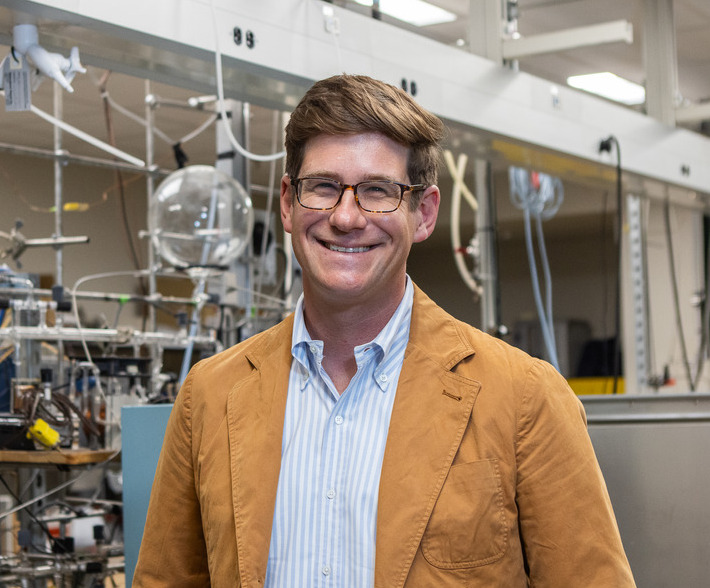
“This award represents an important investment in UTulsa’s research enterprise and in the advanced infrastructure our faculty and students need to address increasingly complex engineering and scientific challenges,” said Michael W. Keller, Ph.D., associate dean for research at the College of Engineering & Computer Science. “It also establishes a capability that can serve researchers and industry partners across Oklahoma and the region.”
XPS allows researchers to determine what elements are present at a material’s surface, their chemical states and how those characteristics change under different environmental conditions. Such information is critical because many processes determining a material’s performance occur at its surface.
“Most of how the environment interacts with a material is through the surface,” Keller said. “Whether researchers are studying corrosion, the weathering of rock or the performance of advanced batteries, understanding the chemistry at a material’s surface can reveal how it will behave under real-world conditions.”
The system will enable research across multiple areas of national importance, including next-generation energy storage, additive manufacturing, catalysts, semiconductor materials and aerospace composites designed for extreme environments. Keller’s research group, for example, plans to investigate how high-temperature composite materials similar to those used for spacecraft thermal protection change when subjected to intense heat.
The new instrument also strengthens UTulsa’s role as a regional research resource. According to Keller, it will be the only XPS system in Oklahoma located within an open-user facility, allowing researchers from other institutions and regional industry partners to conduct advanced measurements at UTulsa rather than sending samples to facilities outside the state.
That shared-resource model can foster new interdisciplinary and multi-institutional research collaborations while providing infrastructure that supports future externally funded research.
The NSF investment will also directly benefit UTulsa students. The College of Engineering & Computer Science plans to incorporate the technology into coursework, research experiences and interdisciplinary learning modules, giving undergraduate and graduate students hands-on experience with sophisticated instrumentation commonly used in advanced research and industry.
The project additionally includes development of a virtual reality training environment that will simulate operation of the XPS system. Students and researchers will be able to develop familiarity with the instrument and its procedures before working with the physical system in the laboratory, expanding training opportunities and helping maximize access to the new facility.
The award represents another step in UTulsa’s continued investment in research infrastructure that connects faculty scholarship, student research, interdisciplinary collaboration and industry engagement. By making an advanced capability available through its Core Facility, UTulsa will strengthen not only research on campus but also the scientific and technological capacity of Oklahoma and the broader region.
Learn more about research conducted by UTulsa Engineering & Computer Science faculty and students at:
https://utulsa.edu/academics/engineering-computer-science/opportunities/ecs-research/