

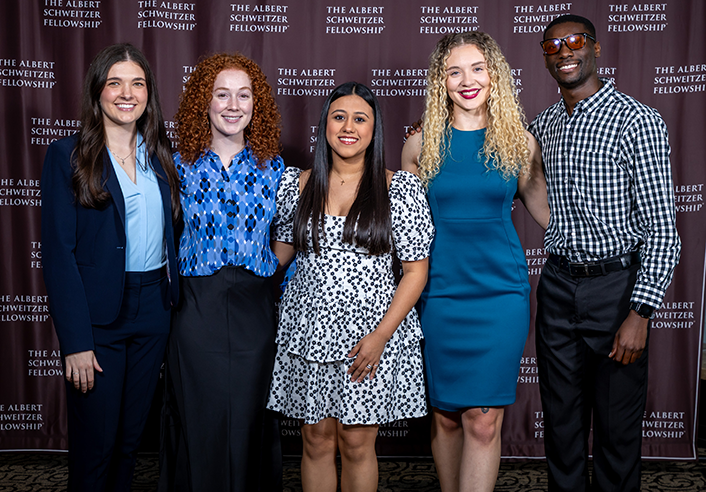
The Tulsa chapter of the Albert Schweitzer Fellowship has welcomed five University of Tulsa students to its 2026-27 cohort. Through projects developed in partnership with local organizations, the Fellows will address needs related to mobility access, financial literacy, STEM education, end-of-life planning and community connection.
“The Tulsa Schweitzer Fellowship develops leaders who have the skills and creativity to build enduring impact through collaboration, compassion and authentic partnership. Fellows learn in real time how to build trust and work across differences,” said Director Emma Morris. “This year, Maddie, Alexa, Maqhawe, Selah and Hannah will sharpen their own self-awareness, approaches to leadership and sense of place in the Tulsa community.”
Supporting independence through mobility education
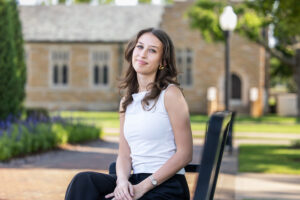
Madeleine Fulk (B.S. ’25), a mechanical engineering master’s student, is partnering with The Center for Individuals with Physical Challenges to support adaptive mobility equipment users.
Her project establishes a wheelchair workshop series that combines hands-on maintenance practice with education and take-home resources for wheelchair users, families and caregivers. The goal is to reduce equipment-related barriers that can result from wheelchair breakdowns, including missed appointments, canceled social activities and limited independence. The project’s overarching aim is to foster independence by building confidence in preventative maintenance tasks and helping participants access and navigate repair resources when needed.
Fulk’s interest in the project grew in part from her family’s experience after a relative suffered a stroke. “My family experienced firsthand the lack of education on how to properly care for a wheelchair once it’s acquired, a gap echoed by members at the center,” she said. “I hope to eventually work as a physical medicine and rehabilitation physician, caring for individuals with physical disabilities.”
Preparing students for financial futures
Alexa Miranda (B.S.B.A ’25), a student at the College of Law, is partnering with Growing Together Tulsa and Will Rogers Middle/High School to develop and teach a business and financial literacy curriculum for students.
The project includes weekly lessons covering budgeting, banking, credit, taxes, saving and investing, student loans and financial planning. High school students also will explore career pathways, hear from guest speakers and participate in a Build a Business Challenge, where they develop and pitch a business idea.
“As a first-generation college student and daughter of immigrants, I experienced firsthand how difficult it can be to navigate financial and educational systems without knowing where to turn for guidance,” Miranda said. “I also recognize that financial stability is closely connected to health and wellbeing. Financial stress can affect the decisions people make about education, housing, healthcare and other essential needs.”
She hopes to give students practical tools and confidence to make informed financial decisions while connecting them with educational and career opportunities.
Sparking curiosity through STEM
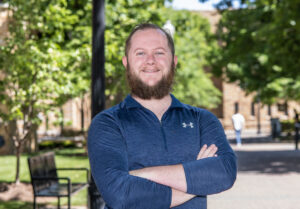
Maqhawe Ndlovu, a doctoral chemistry student, is partnering with Sequoyah Elementary School to create the Curious Minds STEM Club, an after-school program designed to increase science exposure and build confidence through hands-on learning.
Ndlovu’s research focuses on synthetic organic chemistry, drug discovery and energy storage technologies, but his passion for mentorship and community engagement inspired him to bring science beyond the laboratory and into the community.
Through interactive activities, mentorship and exposure to different career pathways, the club will introduce students to science, technology, engineering and mathematics at an early age.
“Exposure matters,” Ndlovu said. “I want students to encounter science at an age when their interests, confidence and ideas about what they can become are still developing.”
Ndlovu hopes the program will allow students see themselves as future scientists, engineers, health professionals and innovators. He also believes early exposure to STEM can play a role in strengthening Oklahoma’s workforce by encouraging more students to pursue STEM pathways long before they begin thinking about college or careers.
Helping families plan ahead
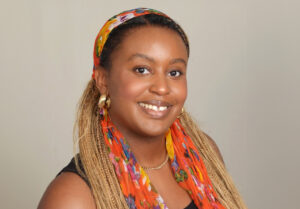
UTulsa Law student Selah Spain is partnering with Legal Aid Services of Oklahoma to bring end-of-life planning resources and reflection to area residents.
Her project, Planning Ahead: Empowering End-of-Life Preparation in Northeastern Oklahoma, includes a traveling three-part workshop series focused on estate planning documents, healthcare decision-making and the emotional aspects of planning for the future. Participants will learn about common legal documents such as advance directives and healthcare powers of attorney while receiving hands-on assistance completing those forms.
Spain’s interest in the subject developed while working as a paralegal, where she saw how difficult it could be for older adults to access legal resources and navigate end-of-life planning. “My project sits at the intersection of law and health, as end-of-life preparation involves not only legal documents but also healthcare decisions and emotional barriers,” she said.
Ultimately, Spain hopes participants leave feeling more informed, prepared and confident in their next steps. “I want individuals to see that planning ahead can be an act of care for both themselves and their loved ones,” she said.
Building community through connection
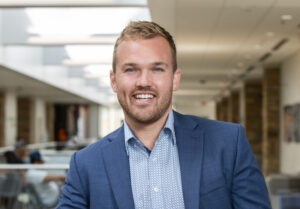
Hannah Tate, also a College of Law student, is partnering with John 3:16 Mission’s Refresh Program to support women experiencing homelessness through activities centered on personal interests and meaningful relationships.
Her project begins by learning what matters most to each participant, whether that is fishing, crafting, journaling or another personal passion. Those interests become the foundation for individual and group activities designed to create opportunities for participants to engage with one another and reconnect with parts of themselves that are often overlooked during times of hardship.
“My project prioritizes connection as a basic need for unhoused women in Tulsa,” Tate said. “By getting to know the core interests of the women in the program, which are often not prioritized during times of hardship, the project aims to restore the Refresh women’s senses of self and connection to a community.”
Through journaling and shared experiences, participants can reflect on those moments and preserve memories they can revisit in the future. Tate hopes the project reminds participants of their value within the Refresh Program and the broader Tulsa community.
About the Albert Schweitzer Fellowship
The Tulsa Schweitzer Fellowship program launched in 2016. It is housed in UTulsa’s Oxley College of Health & Natural Sciences and is one of 10 ASF sites across the United States. To date, 127 Tulsa Schweitzer Fellows have contributed more than 26,000 hours to improve the lives of over 10,000 under-resourced Tulsans in partnership with 70+ Tulsa and eastern Oklahoma nonprofits, schools and clinics. More than 70% of the projects are sustained in some way past the first year.