





Every day, companies generate massive amounts of information – earnings calls, corporate disclosures, patent filings, etc. Most of it is unstructured and goes underused.
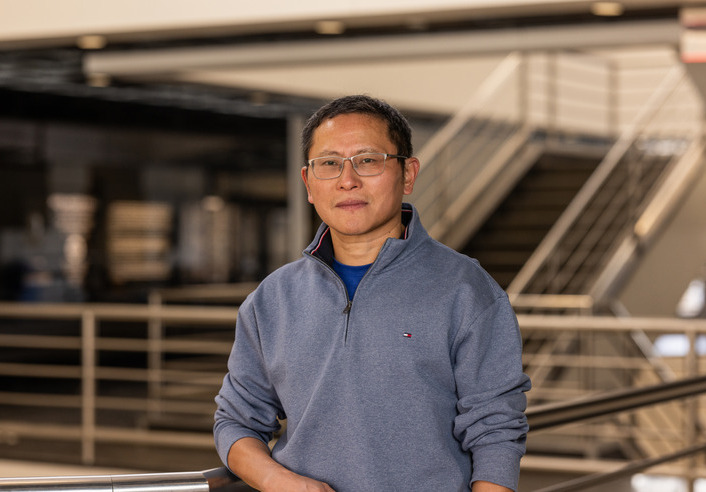
That is the focus of Nan Hu, Ph.D., Philip A. Chapman Chair in Accounting in The University of Tulsa’s Collins College of Business, whose research examines how unstructured information – especially language – creates value in capital markets.
“What we call this is the valuation of information,” he said.
Hu’s work moves beyond traditional financial metrics to analyze how firms communicate risk, strategy and sentiment through text and speech. Using artificial intelligence, machine learning and large language models, he converts qualitative disclosures into measurable data.
Hu and his collaborators have built a dictionary, Bert, and LLM-based models to quantify numerous compelling, hard-to-measure firm-level proxies from two decades of corporate disclosure. These proxies encompass key dimensions such as companies’ perceived artificial intelligence risks, AI ethics, trade war risk, population aging, employee-friendly corporate culture, executive myopia and management accounting capability. By transforming qualitative language into numerical indicators, the research links perception to firm behavior, innovation and stock market outcomes.
At scale, that approach has produced one of the field’s most widely used tools. In 2018, Hu founded a machine learning and AI-powered financial text analytics platform that collects, extracts, cleans and structures unstructured data of publicly listed compaines in China and the United States. Through this system, for example, research can either retrieve pre-calculated proxies or generate customized metrics within five minutes, analyzing how CEO’s have discussed AI ethics in conference calls over the past 10 to 15 years. The platform is now used by researchers across more than 300 universities worldwide and supports work published in top journals across multiple disciplines.
The research reflects a broader shift. As unstructured data becomes dominant, the ability to interpret it quickly, accurately and at scale has become essential.
Hu’s current work pushes that shift further. He is developing AI agents designed to automate complex workflows in highly regulated industries, such as auditing and legal compliance. These systems possess the capability to comprehend intricate regulatory frameworks, design tailored risk-control-evidence structures specific to an individual company’s needs, gather evidence, analyze risks and generate comprehensive reports, significantly accelerating operational productivity.
As organizations move beyond using AI as a conversational tool and begin integrating autonomous agents into daily operations, the focus shifts from AI-assisted work to AI-driven work. As automated decision-making becomes more common, important questions about oversight, accountability and risk emerge.
“When AI agents make the decisions for you, we as humans fundamentally need to understand the boundaries,” Hu said. “Consequently, transparency, explainability and responsibility becomes paramount.”
At The University of Tulsa, that work is shaping both research and the classroom. Hu brings real-world applications of AI and data analysis into his teaching, preparing students to navigate a business environment where information and the ability to interpret it drives decision-making.
“We really hope we can change the world in a positive way, by transforming students’ lives and the field itself,” he said.