




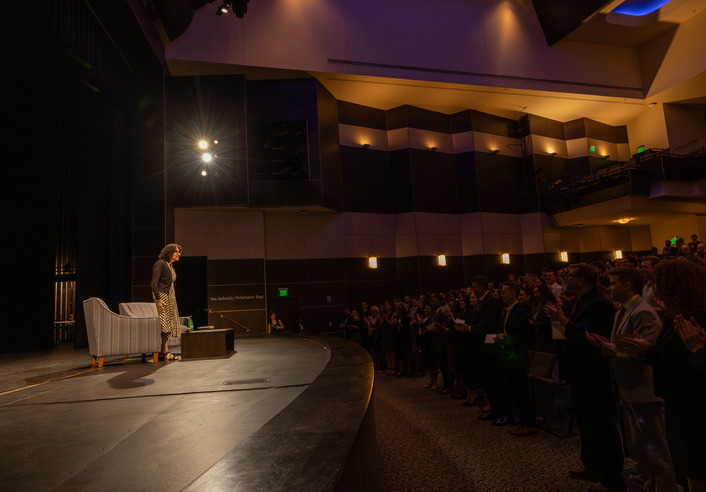
More than 600 students, faculty and guests gathered at The University of Tulsa on Wednesday, Sept. 16, for a conversation with U.S. Supreme Court Justice Sonia Sotomayor, who answered questions from UTulsa Law students about constitutional interpretation, advocacy and professional growth.
The event, moderated by UTulsa’s College of Law Interim Dean Lyn Entzeroth, was part of the Judge Stephanie K. Seymour Lecture Series, which honors Seymour’s distinguished judicial career and longstanding commitment to mentoring future generations of lawyers.
“Hosting Justice Sotomayor was a remarkable opportunity for our law school and our community,” said University of Tulsa President Stacy Leeds (J.D. ’97). “Her reflections on leadership, mentorship and public service, combined with her willingness to engage openly with students, exemplified the kind of meaningful learning experiences that shape future lawyers and leaders. We were honored to welcome her back to campus while celebrating Judge Seymour’s extraordinary legacy.”
Throughout the conversation, Justice Sotomayor emphasized that judges must remain grounded in the law, even when cases involve difficult consequences.
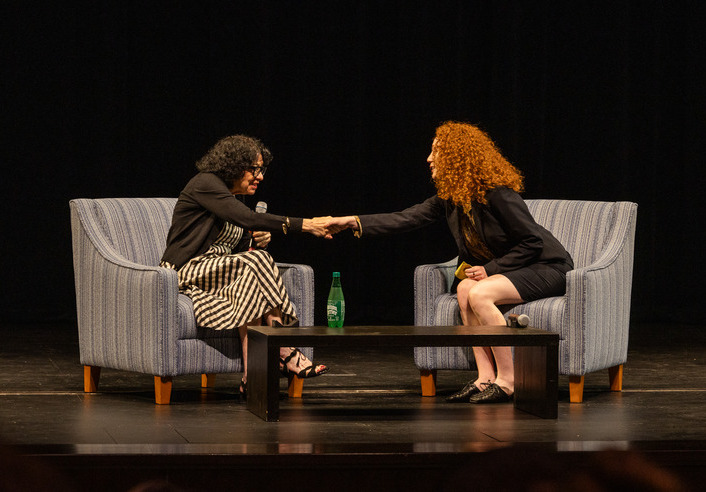
She also challenged the notion that legal questions are always straightforward, noting that much of the work of lawyers and judges takes place in areas of uncertainty and competing interpretations. “Most people think the law is black and white, but the law is gray,” she said. “That’s why we need lawyers.”
Students asked Justice Sotomayor about advocacy and persuasion in a time of increasing division. She encouraged future lawyers to begin by understanding the motivations and concerns of those who disagree with them. “The nuance is always dealing with the other person’s perspective first,” she said.
For some students, one of the most memorable moments came when Justice Sotomayor spoke candidly about self-doubt. Recalling her first year of law school, she described being hesitant to speak up in class and emphasized the importance of believing in one’s own abilities. “Nothing is fatal,” she said. “Trust yourself.”
Reflecting on the event, UTulsa Law student Avion Silas said one of the most meaningful takeaways was Justice Sotomayor’s discussion of confidence and growth.
“What stayed with me most from Justice Sotomayor’s remarks was her description of the journey from ‘I think I could change the world’ to ‘Why did I think that?’ to ‘I know I can,'” Silas said. “Justice Sotomayor’s words reminded me that belonging is not the same thing as blending in. We do not honor the people who opened doors for us by becoming less of ourselves once we walk through them.”
UTulsa Law student Hannah Tate said she was equally struck by Justice Sotomayor’s perspective and approach to others. “I was moved by how grounded in humility Justice Sotomayor is,” Tate said. “Her commitment to honoring the humanity of everyone she meets is palpable, and it was quite special to witness that firsthand.”
When asked what continues to motivate her after years on the Supreme Court, Justice Sotomayor pointed to opportunities to connect with students and future lawyers. “I think you’re our future,” she said. “If I can inspire you to be a better lawyer, a better person, I’m having a good day.”