





As the United States races to strengthen its energy independence, secure domestic supplies of critical minerals and modernize its electrical grid, researchers at The University of Tulsa are working at the intersection of some of the nation’s most important energy challenges.
Aaditya Khanal, Ph.D., associate professor in UTulsa’s Russell School of Chemical Engineering, and McDougall School of Petroleum Engineering is leading research that connects carbon storage, critical mineral recovery, renewable fuels, grid-scale energy storage and advanced materials. Together, these efforts aim to address a fundamental national question: How can the United States build a more secure, resilient and competitive energy future?
Much of modern energy technology depends on materials that are increasingly important to national security and economic competitiveness. Critical minerals such as nickel are essential for batteries, advanced manufacturing, defense technologies and energy storage systems. At the same time, the nation continues to seek scalable solutions for managing carbon emissions while maintaining reliable and affordable energy supplies.
Khanal’s research explores whether these challenges can be addressed simultaneously.
His laboratory initially focused on carbon dioxide mineralization, a process that permanently stores carbon dioxide underground by converting it into stable rock formations. More recently, the research has expanded to investigate whether the same geologic reactions that lock away carbon dioxide can also release valuable critical minerals from underground formations.
“What makes this research exciting is the possibility of creating multiple benefits from a single process,” Khanal said. “If we can permanently store carbon dioxide while also recovering critical minerals needed for energy technologies, the economics and impact of carbon management could change significantly.”
Early laboratory findings suggest that certain underground rock formations may temporarily release nickel as carbon dioxide reacts with minerals in the rock. Understanding when and how that occurs could eventually help researchers design systems that permanently store carbon while creating a domestic source of minerals vital to energy infrastructure, electrification and advanced technology manufacturing.
The implications extend well beyond carbon storage. A successful approach could contribute to strengthening domestic supply chains for materials that are increasingly important to energy resilience and national security.
Khanal’s broader research portfolio addresses additional challenges associated with America’s evolving energy system. His team recently examined how excess electricity generated from wind and solar power could be converted into renewable methanol, creating a pathway to store energy and produce transportation fuels and industrial feedstocks. Such approaches could help improve the efficiency and reliability of increasingly diverse energy systems.
His work also supports advances in grid-scale energy storage, a critical component of maintaining reliable electricity as demand grows and energy infrastructure becomes more complex.
These efforts are supported through collaborations with the U.S. Department of Energy and the National Science Foundation and involve researchers across multiple disciplines at UTulsa. Current projects connect expertise in chemical engineering, electrical and computer engineering and economics, spanning fundamental science, technology development, grid optimization and commercialization readiness.
The research aligns closely with The University of Tulsa’s growing leadership in energy innovation through the Oklahoma Initiatives for Energy (OKIE). As the nation seeks solutions that strengthen energy reliability, expand domestic resource development and improve economic competitiveness, UTulsa researchers are advancing technologies that support all three objectives.
Equally important, students are active participants throughout Khanal’s research enterprise. Undergraduate and graduate students contribute to projects involving carbon storage, critical minerals, advanced materials, renewable fuels and energy-system modeling, gaining hands-on experience with challenges of national and global significance.
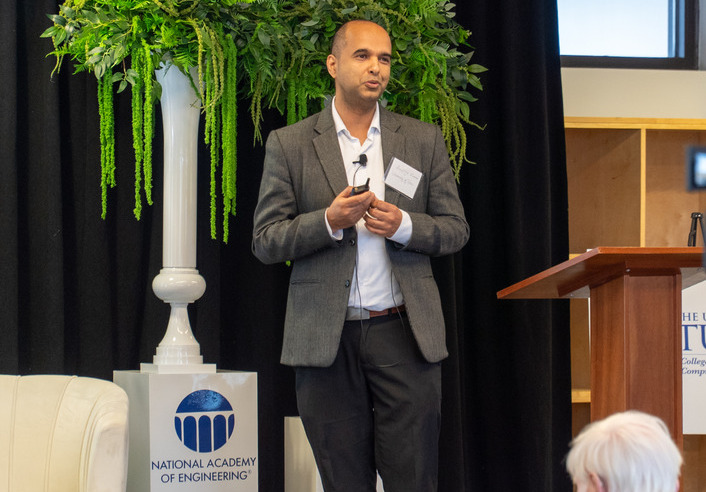
The growing impact of the program reflects both Khanal’s leadership and UTulsa’s commitment to addressing real-world problems through interdisciplinary research. Recently promoted to associate professor with tenure, Khanal has presented his team’s work to leaders in academia, industry and government, including at the National Academy of Engineering Mid-Continent Regional Meeting and DOE research meetings.
By connecting disciplines that are often studied separately, Khanal and his collaborators are positioning The University of Tulsa as a national contributor to energy security, technological innovation and workforce development.