
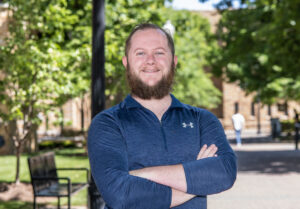
Who controls health data, and who benefits from its use? UTulsa nursing major Aeric Beck, a Cherokee Nation citizen, explored those questions through a CDC-funded tribal public health internship last summer. Beck studied how federal research protections can overlook tribal sovereignty and community rights, particularly for Indigenous people living outside reservations, and developed a framework to strengthen tribal authority over research data. His work highlights a broader healthcare challenge: ensuring research respects and benefits the communities it examines.
Bachelor of science in nursing student Aeric Beck spent eight weeks this summer taking part in the Tribal Health Experiential Internship Seminar (THESIS), a virtual paid internship focused on promoting tribal public health. The Centers for Disease Control and Prevention (CDC) Office of Science funds THESIS through its Lewis Scholars Program.
A citizen of the Cherokee Nation from Bixby, Beck describes his THESIS experience as “truly transformative.” Two of the central benefits were a growth in his understanding of the health disparities affecting American Indian and Alaska Native communities, alongside a re-energizing of his commitment to advancing Indigenous public health.
“I also had the privilege of connecting with public health professionals, learning from Indigenous leaders and gaining valuable perspectives from experts across a wide range of disciplines,” Beck noted. “The relationships I built and the knowledge I gained will, I am certain, exert a lasting influence on my personal and professional growth.”
“I am immensely proud of Aeric and his commitment to prevention, health literacy and healthcare access and equity,” said Cassy Abbott Eng, associate dean and executive director of the School of Nursing at Oxley College of Health & Natural Sciences. “As a THESIS intern, Aeric connected his nursing lens to Native American culture, resilience and public health, while strengthening his professional preparation and future impact on his patients and their communities.”
Beyond the reservation
Beck has long been captivated by what he calls the “sharp edges” where policy collides with real life. Drawing on his own situation, he observed that, “growing up as a gay citizen of the Cherokee Nation, I quickly realized many of the systems I had to navigate were never designed with people like me in mind.” Over time, that awareness evolved into a commitment to understand how government, policy and systems of power shape, enable and constrain access to healthcare across Oklahoma.
In keeping with this interest in the intersection of power, identity and healthcare, Beck’s THESIS journey entailed in-depth research on how government policies frequently constrain Native self-determination. “I also sought to understand,” he said, “how they perpetuate inequities rooted in colonization and the federal government’s intervention in Indigenous governance, culture and social structures.”
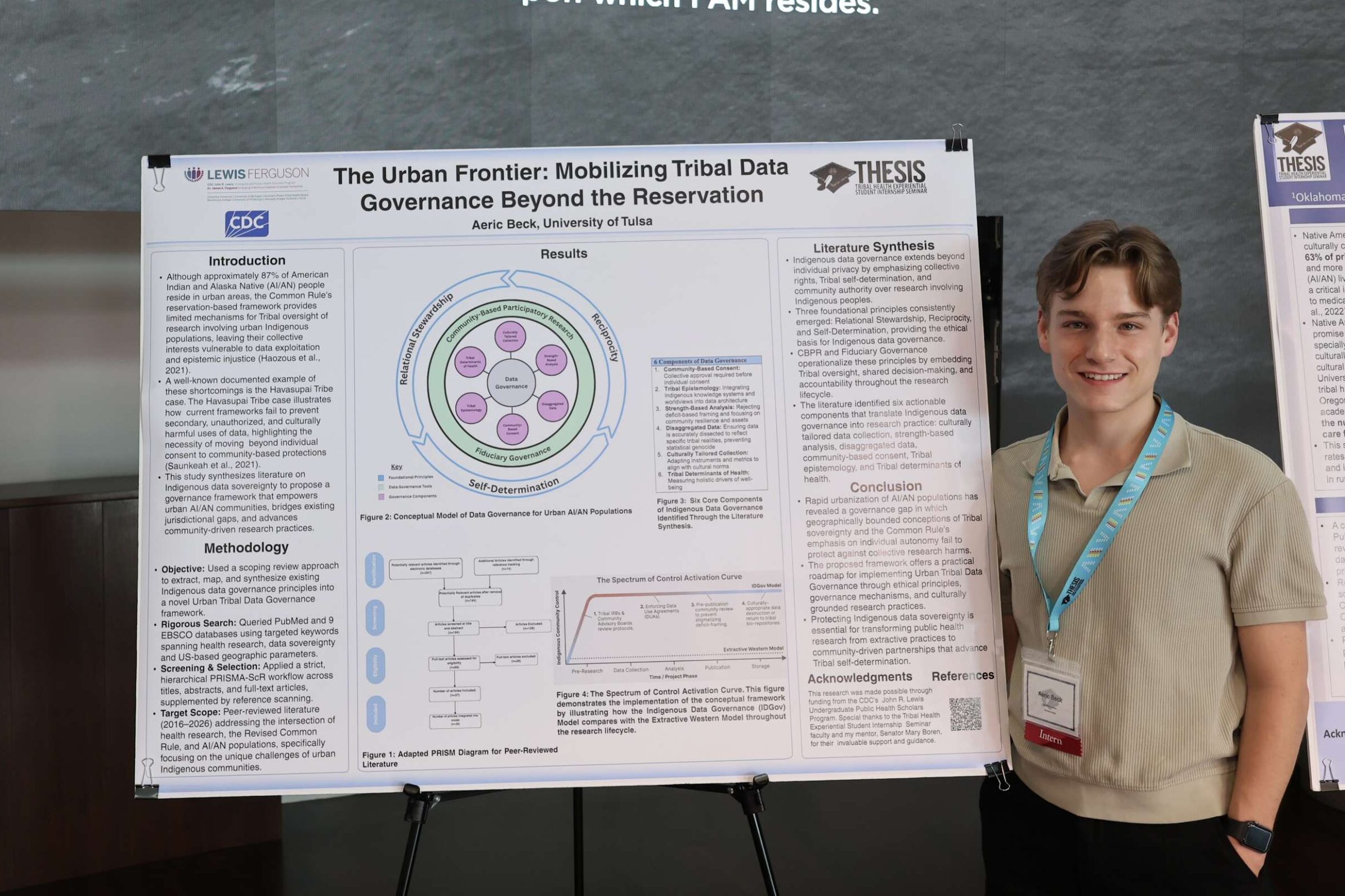
Titled “The Urban Frontier: Mobilizing Tribal Data Governance Beyond the Reservation,” Beck’s project focused “on the Federal Policy for the Protection of Human Subjects – colloquially known as the Common Rule – and its privileging of individual autonomy while failing to safeguard the collective rights and sovereign authority of tribal nations in research involving urban Indigenous populations.” At the heart of his work, he explained, “was the fact that the Common Rule’s neglect of community-level protections enables extractive research that prioritizes the objects of external institutions over tribal sovereignty, meaningful data governance and the equitable distribution of research benefits.”
Beyond identifying this problem, Beck’s 10-year literature review identified key principles of Indigenous data governance. He then used these findings to inform the development of a conceptual Urban Tribal Data Governance framework for research involving urban Native American and Alaska Native populations.
At the end of the THESIS internship, Beck joined his fellow interns – whom he had gotten to know through videoconferencing and text messages – and shared his poster at the in-person THESIS Showcase held in Oklahoma City. “Connecting face to face with the people I had spent so much time working alongside made the experience especially meaningful and rewarding,” he noted.
Mentorship and engagement
A foundational element of THESIS was the pairing of each intern with a mentor. Beck’s mentor was Oklahoma Sen. Mary B. Boren. In addition to providing encouragement, accountability and research guidance, Boren made it possible for Beck to take part in several professional development events, including the Sovereignty Symposium XXXVIII in Oklahoma City and the Cherokee Nation Healthcare Economic Impact Summit, and to join the Massachusetts Developmental Disabilities Council, the Council of State Governments (CSG) and CSG East for the 2026 Medicaid Summit.
“I am immensely grateful for Sen. Boren’s generous support,” Beck commented. “The doors she opened allowed me to engage with policymakers, healthcare professionals and other public health leaders, while gaining a greater understanding of the importance of professional relationships and collaboration.”
“The chance to serve as a mentor for Aeric through the THESIS program was a true highlight of my summer,” Boren said. “I always enjoy drawing upon my experience within the academic community in Norman to support research efforts within the Native community. Aeric’s dedication to honing his research focus and his active involvement in the Sovereignty Symposium highlight his strong commitment to scholarship. I’m encouraged and inspired by Aeric’s talent and vision to create meaningful, positive change within Native research and his nursing career.”
A busy final year
Beck is now back in student mode, completing his senior year of coursework and clinical rotations. He is also involved in a panoply of extracurricular activities. These include serving as a student representative on the Dean’s Advisory Board for Oxley College of Health & Natural Sciences and as the treasurer of the UTulsa Student Nurses’ Association. He is also a student fellow in the Oklahoma Center for the Humanities’ Mellon-funded Sovereignty and Democracy in Indian Country initiative and a student adviser on the University of Oklahoma Health Sciences Center’s Community Advisory Board, supporting a pilot study examining HPV vaccine uptake among Native American and Alaska Native university students.
Closely related to his nursing studies, one of Beck’s most rewarding activities is volunteering with the Student Community Resource Unit for Baseline Support (S.C.R.U.B.S.) at the John 3:16 Mission Center. “My involvement in S.C.R.U.B.S. has broadened my understanding of structural inequities, strengthened my commitment to advocate for solutions grounded in dignity and equity and, most importantly, challenged me to reconsider how society understands homelessness,” he said. “I encourage all nursing students to consider getting involved.”
In his free time, Beck enjoys playing French horn as a member of UTulsa’s Symphony Orchestra. And he adds to the excitement on game days by playing mellophone with the Sound of the Golden Hurricane marching band.
Motivations and horizons
Beck’s decision to become a nurse was catalyzed by learning, when he was a teenager, that before he was born his mother had given birth to a child named Ashlyn, who passed away after 10 days.
“Despite the immense grief she experienced, my mom often speaks about how a nurse in the neonatal unit helped her survive the unendurable, offering both medical support and empathy in the hospital and after,” Beck recounted. “Because of this, I became determined to follow in the nurse’s footsteps and improve the maternal experience by advocating for stronger support systems for pregnant individuals and their families. I plan to bring this dedication directly to my nursing practice.”
On the not-too-distant horizon, he has his sights set on enrolling in a master of public health program, focusing on health policy. Simultaneously, he plans to advance his nursing expertise by earning a master of science in nursing, focusing on women’s health. “I see these degrees not as separate paths,” he said, “but as complementary ways to address health inequities from both the bedside and the policy table.”
What kind of future do you want to create?
No two students are alike. At Oxley College of Health & Natural Sciences, we collaborate with individuals to help them achieve their personal, academic and professional ambitions. We would be honored to welcome you to this supportive community.