




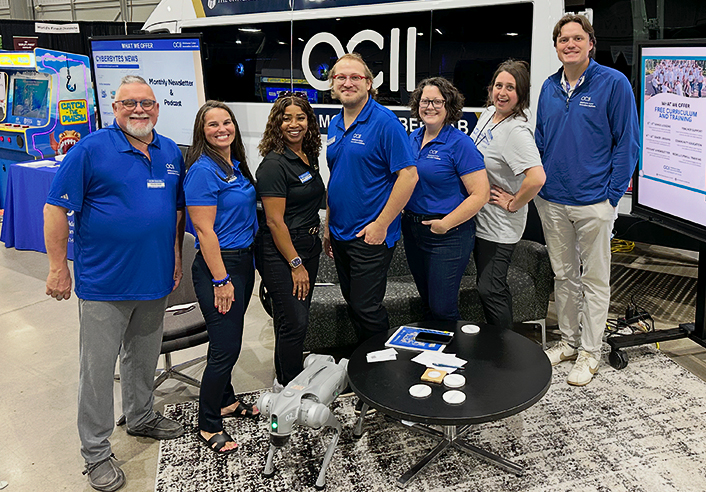
When roughly 4,000 educators from across Oklahoma met in Tulsa for the 59th Annual Oklahoma Summit, The University of Tulsa’s Oklahoma Cyber Innovation Institute (OCII) was there to share encouraging news: Teachers don’t have to go back to school in order to teach cybersecurity in their classrooms. OCII offers free turnkey curriculum for all Oklahoma high school and middle school teachers.
OCII Educational Programming Director Tywania Griffin explained that the CyberQuest curriculum is designed to teach students how cybersecurity affects their everyday lives. It covers the basics, like creating secure passwords and understanding that “free Wi-Fi” isn’t necessarily free and then builds into more advanced topics like encryption and coding.
“It’s a process where from Day One, a teacher could learn and grow with their students,” she said. “And by the end of the year, they could be a professional in cybersecurity, and their students could take our certification exam and be certified as a cybersecurity support specialist.”
Griffin said she’s passionate about cyber education because we’re living in a world where everyone, from kindergarten into adulthood, is touching a device that’s online daily. Ideally, students can take the lessons they learn from the CyberQuest curriculum and share that knowledge with their families at home.
“It’s very important that they’re cyber aware and that they don’t become victims to the many things that are out there, from cyber scams to phishing,” she said. “We just want to make sure that we’re doing our part to keep everyone safe.”
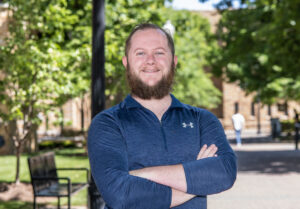
Timothy Crisp is an OCII curriculum designer and a doctoral student in cyber studies at UTulsa. As a former Tulsa Public Schools English teacher who was suddenly tasked with teaching cybersecurity to his students, Crisp designed CyberQuest with his former colleagues in mind. He’s also pursuing interdisciplinary research on how these lesson plans should evolve with the fast-paced nature of the industry.
“I’m really focusing on a couple of things,” he explained. “First, how do we analyze frameworks to create objectives for the curriculum, so that curriculum can be changed when the industry changes and doesn’t get set in stone with standards that a lot of K-12 curriculum is plagued with? Also, how do we create a curriculum that can be taught by people who don’t have a background in the subject, so that they don’t have to go back to college?”
Crisp credits Professor of Cyber Studies John Hale, Ph.D., for creating a partnership with Tulsa Public Schools that led to an opportunity for Crisp to pursue his passion, combining K-12 education and cyber studies. As the curriculum designer, Crisp proudly presented CyberQuest to educators at the Oklahoma Summit in August.
“It just feels great to finally get to accomplish dreams,” he explained. “And to have The University of Tulsa behind me, to help me accomplish those goals, has been one of the best parts about it. I think UTulsa is just a fabulous institution. I come from another, larger institution for my undergrad and my master’s degree, but The University of Tulsa is truly the first place I felt like I was fully connected with people who want to support me in my professional and academic growth.”
OCII’s educational programming team is working to take the fear out of teaching a new course for K-12 teachers. If you are an educator and you would like to learn more about the cybersecurity resources available to you, contact OCII via their website. They’re also preparing to launch a podcast and newsletter for cybersecurity educators, allowing teachers to stay up to date on the latest from OCII.