




Last fall, students in UTulsa’s B.C. Franklin Legal Clinic took on one of the first cases filed under Oklahoma’s Survivors’ Act, which gives domestic violence survivors a chance to have their sentences reduced. The students researched evidence, met with their client in prison and advocated for her in court. Although the resentencing request was denied, the case is now on appeal and could shape how the law is applied in the future. The effort highlights the power of hands-on legal education and the potential for new justice for survivors.
When Oklahoma’s Survivors’ Act took effect in August 2024, it created a new legal pathway for survivors of domestic violence seeking resentencing when abuse was a substantial contributing factor to the offense for which they were convicted.
Less than two years later, students in the Buck Colbert Franklin Legal Clinic at The University of Tulsa’s College of Law found themselves working on one of the first cases brought under the new law.
The case involved Shonna Perry, a woman serving a sentence for arson who sought relief under the Survivors’ Act based on a documented history of domestic violence. According to evidence reviewed and presented by clinic students, Perry spent years in a relationship marked by physical, emotional, psychological and financial abuse. The record included multiple protective orders, calls to a domestic violence hotline, periods spent in a domestic violence shelter, reports of stalking and harassment and incidents in which the violence extended to Perry’s oldest child.
Despite multiple attempts to seek help, the abuse continued. Students argued that the violence escalated over several years and left Perry increasingly isolated and dependent on her abuser. According to the Application prepared by the clinic, the offense occurred after another violent incident involving physical abuse of Perry at her abuser’s home, which they did not share. The following day, Perry set fire to the residence where she had most recently been abused and where her abuser was known to be staying.
Under the Survivors’ Act, the team was required to prove by clear and convincing evidence that Perry was a victim of domestic violence and that the abuse was related to and a substantial contributing factor to the offense. Because of the nature of the underlying offense, the students also had to satisfy an additional statutory requirement by demonstrating that the victim of the crime was Perry’s abuser.
The case was only the sixth heard under the Survivors’ Act since it was enacted, placing students at the forefront of a developing area of Oklahoma law.
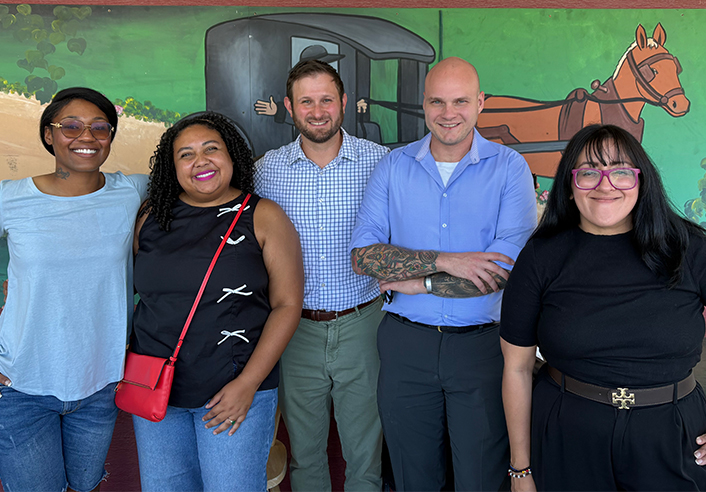
Over the course of several months, clinic students Chris Robinson (’26), Jeff Smith (’25), Tre’Anna Hinds (’26) and Paula Carbin (’26) worked under the supervision of Assistant Clinical Professor of Law Alexander Gavern and Staff Attorney Courtney Hartwell to build the case from the ground up. Their work included multiple visits with Perry at Dr. Eddie Warrior Correctional Center, extensive review of court records and evidence, preparation of witness and exhibit materials and drafting nearly every pleading required for the case.
“Working on Oklahoma Survivors’ Act cases was an honor because these cases are the survivors’ opportunity to tell their story and be heard,” Robinson said. “Aside from the opportunity to gain practical experience investigating claims, working through discovery, and drafting papers for the court, working on these cases offered an opportunity to help present someone’s story and make it impactful.”
Building a case from the ground up
Students reviewed extensive documentation, including court records, protective orders, criminal case discovery, text messages, social media records and other evidence. They drafted the initial Request to Apply under the Survivors’ Act, discovery requests, the formal Application for Resentencing, witness and exhibit lists, proposed orders and additional filings required by the court.
The preparation extended well beyond paperwork. Students developed witness examinations, prepared legal arguments, practiced hearings in class and worked directly with Perry to prepare for testimony. They also helped ensure that Perry understood each stage of the process and what to expect in court.
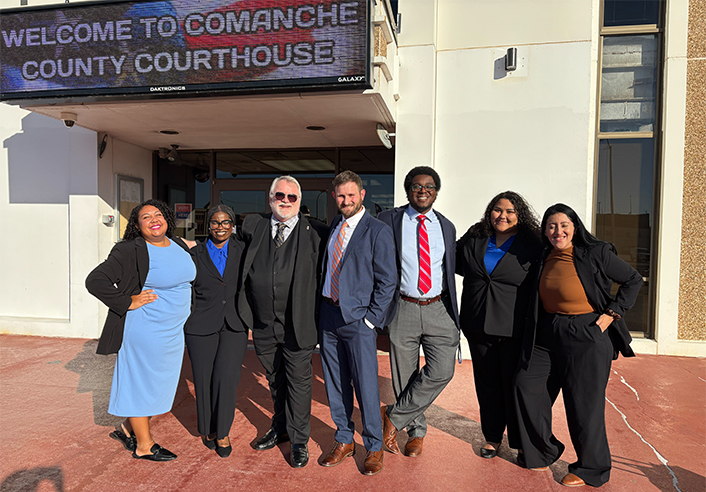
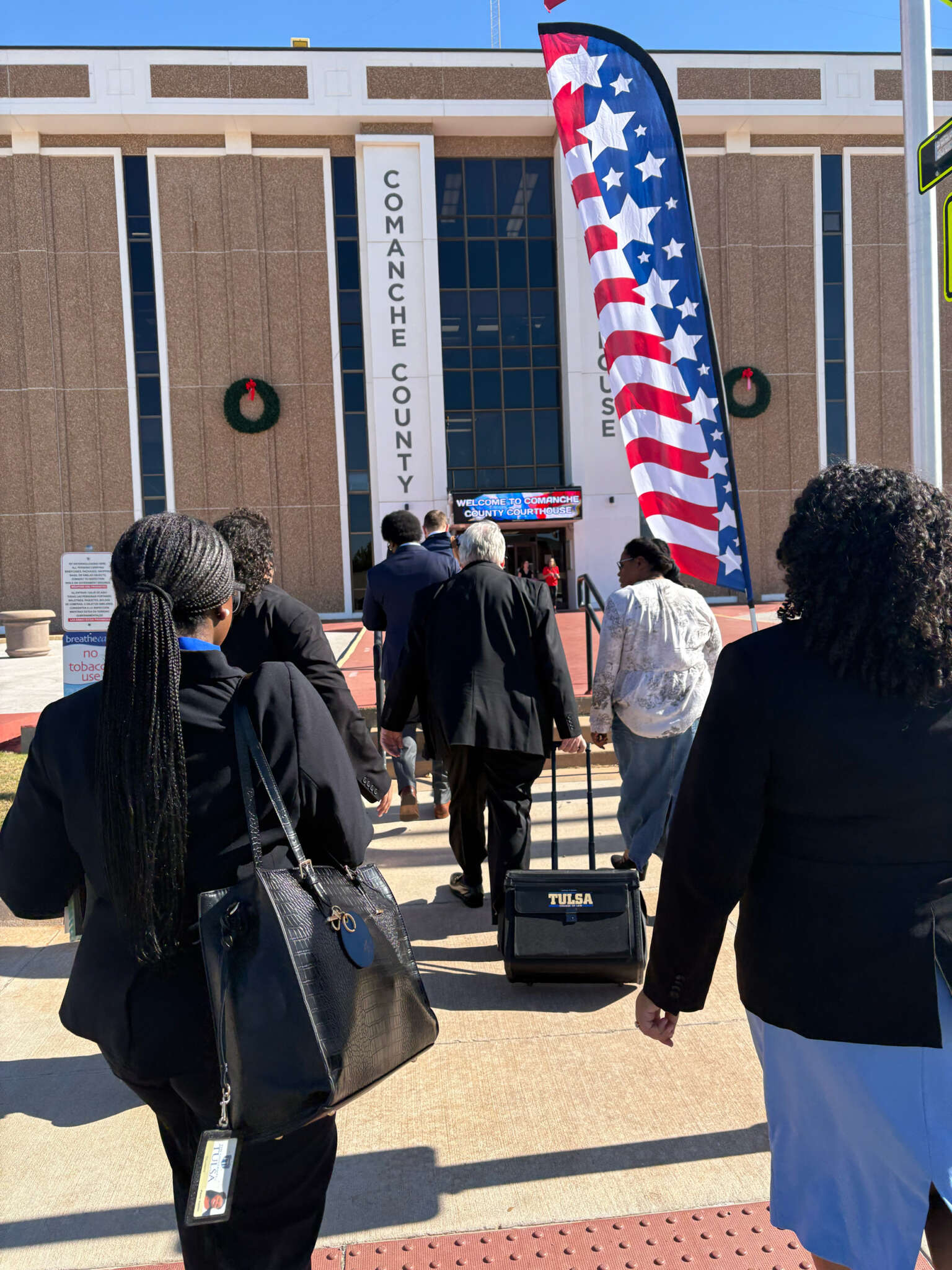
In November 2025, the team traveled to Lawton, Oklahoma for the resentencing hearing.
Hinds delivered the opening statement and closing argument, connecting months of investigation and evidence gathering to the legal arguments presented at the hearing. Carbin conducted the direct examination of Perry, helping present the facts underlying the application.
The hearing also exposed students to unresolved questions surrounding implementation of the new law, including disputes over evidentiary standards and procedural issues that courts are still working through.
Although the court ultimately denied the application, the students’ work did not end there.
Following discussions with Perry, the clinic elected to pursue an appeal to the Oklahoma Court of Criminal Appeals. According to clinic supervisors, Perry wanted to continue the case not only because of its impact on her own circumstances but also because appellate guidance could help future applicants seeking relief.
From law students to advocates
Robinson took a leading role in drafting appellate filings over winter break, including the Brief in Support of Petition in Error, which was filed in January 2026.
For Robinson, one of the most meaningful aspects of the experience was the opportunity to work directly with clients and witness their commitment to the legal process.
“One of the highlights of my time working on Oklahoma Survivors’ Act cases was meeting with our clients,” Robinson said. “Each client was invested in the process and made it easy to help them tell their story. I was also surprised at the way our clients thought about their cases within the bigger picture of how it might impact another survivor’s case. It just showed a positive side of humanity out of places where people typically think it does not exist.”
the case has already left a lasting impact. For the students who worked it, the experience provided an opportunity to move beyond the classroom and advocate for a real person facing significant legal challenges. Their work may also help shape how future courts interpret Oklahoma’s Survivors’ Act and how future survivors seek relief.
Perry was released from custody and reunited with her family in August 2026.
An impactful education
If you are seeking a law school that offers an excellent academic experience as well as invaluable legal clinic opportunities, please visit utulsa.edu/law to learn more.