




Artificial intelligence is transforming industries across the globe. At The University of Tulsa, students are using it to tackle a deeply human challenge: helping people who rely on prosthetic limbs live more comfortably and confidently.

In collaboration with the Biomechanics Research Laboratory directed by Roger Kollock, Ph.D., associate professor of athletic training and exercise & sports science, John M. Henshaw, Ph.D., who serves as the Harry H. Rogers Endowed Chair in Mechanical Engineering, is working with students to combine engineering, healthcare and machine learning to better understand what makes one prosthetic device feel more comfortable than another.
The project brings together students from multiple disciplines to explore whether artificial intelligence can identify subtle movement patterns that influence prosthetic performance. Their work has the potential to improve how prosthetics are evaluated, prescribed and customized for individual users.

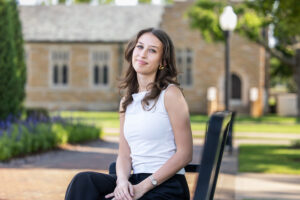
For Maddie Fulk, a master’s student in mechanical engineering who received her bachelor’s degree in exercise & sports science from UTulsa in 2025, the research represents the future of engineering.
“Dr. Henshaw has recognized how important artificial intelligence and machine learning are becoming in our field,” Fulk said. “He believes every engineering student should graduate with exposure to these tools and understand how they can be used to solve real-world problems.”
That vision is becoming reality inside the laboratory.

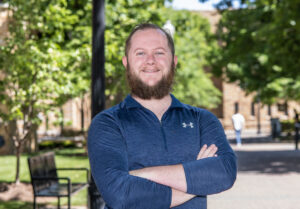
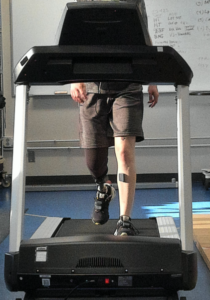
Working alongside mechanical engineering senior Maura Wahl of Minneapolis, Fulk analyzed data collected in the Biomechanics Research Lab from individuals with below-the-knee amputations as they walked using different prosthetic devices. Motion sensors placed throughout the body captured hundreds of measurements related to gait, balance and movement.
Using machine-learning techniques, the students examined the data to determine which measurements best distinguished one prosthetic from another.
The results surprised even the researchers.
While sensors were placed throughout the lower body, the machine-learning model consistently identified movement near the pelvis as one of the strongest indicators of differences between prosthetic devices. The finding suggests that subtle changes near the body’s center of mass may provide valuable information about how users experience different prosthetics.
“The model was very successful,” Henshaw said. “It revealed patterns that would have been difficult to identify using traditional approaches alone.”
The project demonstrates how artificial intelligence can uncover meaningful insights from complex data while helping researchers focus on the measurements that matter most.
For Wahl, the work is particularly meaningful because of its potential impact on people’s lives.
“Many people don’t realize there could be a better option,” she said. “Some individuals are using prosthetics that don’t work well with their bodies because they don’t know alternatives might exist.”
Building on their discovery, the team is now exploring how the same information could someday be collected using technology many people already carry every day: smartphones.
Rather than relying solely on specialized laboratory equipment, researchers are investigating whether sensors built into mobile devices could gather similar movement data during everyday activities. Such an approach could make prosthetic evaluation more accessible and scalable while expanding opportunities for future research.
The project exemplifies The University of Tulsa’s commitment to student-driven research, experiential learning and campus-wide collaboration. Students are not only diving into emerging technologies such as artificial intelligence and machine learning, they are applying those tools to challenges at the intersection of engineering and human health.

“This is exactly the type of experience that distinguishes a UTulsa education,” said Andreas Polycarpou, Ph.D., dean of the College of Engineering & Computer Science. “Our students are working alongside faculty mentors to address meaningful real-world problems, leveraging cutting-edge technologies such as AI while developing the skills, creativity and leadership needed to make an impact in their professions and communities.”

Ron Walker, Ed.D., dean of the Oxley College of Health & Natural Sciences, pointed to the advances that can be made when students and faculty from different departments share labs, data and findings. “This work shows what is possible when disciplines across campus come together,” he said. “By combining health sciences, engineering, student research and faculty mentorship, we are creating new pathways to solve real-world problems and improve lives.”
The experience is already shaping career aspirations.
Fulk plans to pursue a career in medicine while continuing to integrate research into patient care. Wahl is considering graduate school and a future focused on prosthetics and biomedical engineering.
For both students, the project represents something larger than a research study. It demonstrates how engineering, artificial intelligence and compassion can come together to improve lives.
And for the people who depend on prosthetic devices every day, that combination has the potential to make a lasting difference.