




 Artificial intelligence is rapidly transforming how people learn, work and solve problems. The University of Tulsa is helping prepare Oklahoma for that future by building an AI education pipeline that extends from K-12 classrooms through undergraduate education, research and workforce development.
As part of this commitment, UTulsa recently launched new Bachelor of Science degrees in artificial intelligence, placing the university among the early U.S. institutions to offer dedicated undergraduate degree pathways in this rapidly emerging field. The new programs build on UTulsa’s existing AI minor and give students opportunities to develop expertise in artificial intelligence and apply it across fields such as engineering, computer science and cybersecurity.
“UTulsa is making a significant commitment to AI education, from Oklahoma’s K-12 classrooms to our newly launched bachelor’s degrees in artificial intelligence,” said Andreas Polycarpou, dean of the College of Engineering & Computer Science. “Our goal is to help build the talent pipeline Oklahoma needs while preparing students to lead in an economy increasingly shaped by AI.”
At the same time, UTulsa is taking AI education beyond its campus. As part of the Tulsa Regional Tech Hub initiative, supported by the U.S. Department of Commerce and Tulsa Innovation Labs, UTulsa is building educational pathways in artificial intelligence, robotics and autonomous systems. For the College of Engineering & Computer Science, those efforts include both university degree programs and curriculum designed for K-12 classrooms.
During the past year, UTulsa professors and students developed an interactive AI curriculum for high school students that combines foundational concepts, hands-on activities and discussions about ethics and societal impact.
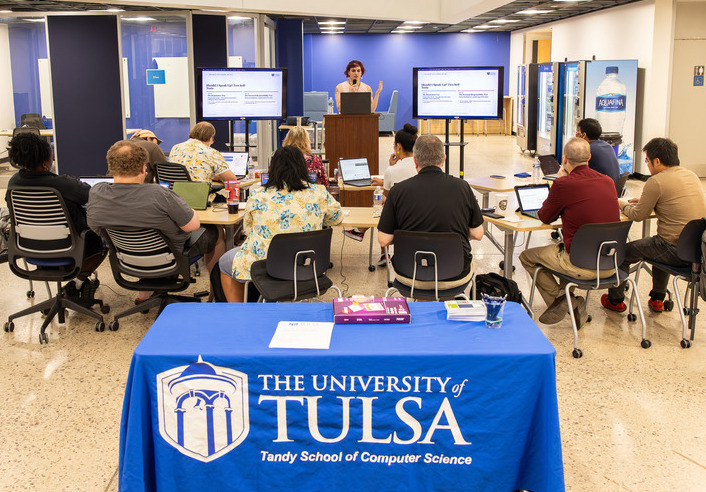 To help Oklahoma educators bring that curriculum into their classrooms, UTulsa hosted a three-day Train-the-Trainer workshop over the summer for high school teachers and other educators. Participants explored AI concepts, experienced the curriculum firsthand and discussed how it could be adapted for their students and schools.
Collaboration was central to the workshop. Breakout sessions, co-design activities and discussions enabled educators to share ideas and provide feedback while giving UTulsa faculty greater insight into the opportunities and challenges teachers encounter when introducing rapidly evolving technology into their classrooms.
For John Hale, Ph.D., professor of computer science and Tandy Endowed Chair in Bioinformatics and Computational Biology, some of the most encouraging moments came during those conversations.
“There were several times when you would hear the teachers say, ‘I’m taking this back into the classroom,” Hale said. “Seeing those moments where you could see them connect the dots with what they were going to do, that was incredibly encouraging.”
The discussions also helped organizers better understand how artificial intelligence education differs between high school and university settings, allowing the curriculum to be refined for a variety of classroom environments.
The workshop’s impact continues beyond the time educators spent on campus. Two pilot schools are now implementing the curriculum through dedicated courses, while several others are incorporating modules into existing classes. UTulsa faculty continue to provide guidance and support as teachers adapt the material for their students.
“We’re continuing to talk and help them roll the curriculum out and deal with issues,” Hale said. “It’s not like you come in for three days and then we forget about you. We see it as a long-term relationship.”
UTulsa also hopes participating educators will form a community that continues to exchange ideas, experiences and best practices as AI education reaches more classrooms across Oklahoma.
The College of Engineering & Computer Science plans to host the Train-the-Trainer workshop annually and expand participation to more educators throughout the state. Together with UTulsa’s new undergraduate AI degree programs, the initiative is part of a broader effort to build a pipeline of AI education and talent from Oklahoma classrooms to university laboratories and ultimately the state’s technology workforce.
A Tulsa native and UTulsa alumnus, Hale is eager to work with area teachers on this initiative. Educators interested in learning more can contact him at john-hale@utulsa.edu.