





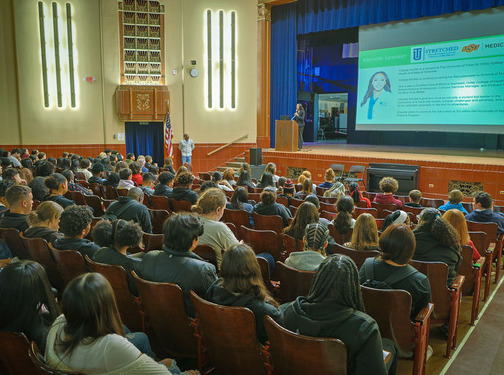
Increasing the number of health care practitioners from limited-income, first-generation, and under-represented minority groups is at the heart of STRETCHED. The program stands for STudents Reaching Excellence Through Collaboration with Higher EDucation. This program introduces Tulsa-area high school students about health care careers, college admission, and financial aid.
Oxley Impact
As a top 100 private research university, and ranked among the best value institutions, Oxley College of Health & Natural Sciences is committed to creating a lasting impact on society through the work of students, faculty, and alumni.
Community

Industry Leadership
More than 75% of the 2.8 million traumatic brain injuries (TBI) occurring each year in the United States are concussions, making it the most commonly diagnosed type of TBI, according to the Centers for Disease Control and Prevention. The Concussion Center is an interdisciplinary initiative housed in the on-campus Mary K. Chapman Clinic for Communicative Disorders. Services include concussion education and rehabilitation, return-to-learn planning, return-to-physical-activity planning, cognitive rehabilitation, vestibular rehabilitation, and concussion-related mental health management.
Innovative TU research targets breast, pancreatic and brain cancer
Associate professor of chemistry and biochemistry Angus Lamar has been undertaking cancer research since he arrived at The University of Tulsa in 2015. Joined by associate professor of chemistry and biochemistry Robert Sheaff, Lamar and his team next began testing those compounds for biological activity against a variety of cancer cell lines. Since 2019, Lamar and Sheaff’s collaboration has resulted in five publications and multiple patents that feature synthetic methods for preparing sulfonamide compounds and screening them for biological activity.
How mussels revealed a century of water quality in Oklahoma
Roberts has pioneered the use of mussels to monitor toxic metal pollution in waterways across Oklahoma. Pollution or climate stress can be observed by studying the growth layers within a mussel’s shell, giving researchers a way to observe how water quality has changed over an extended period of time. “We have seen that mussels are great indicators of water quality and the overall health of an ecosystem,” Roberts said.

This fellowship is a huge accomplishment for any young scientist, but receiving the NSF GRFP is the result of a mosaic of support and community from mentors, friends and educators.
Karina Cunningham, National Science Foundation Fellow B.S. ’22