
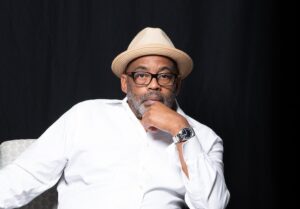
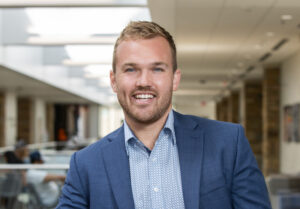
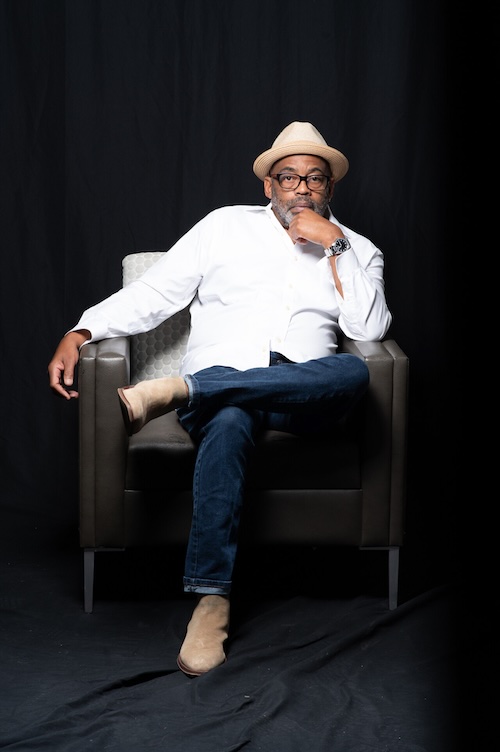
Quraysh Ali Lansana, applied associate professor of English & creative writing, is a distinguished scholar of African American studies, journalist and author of 23 books including poetry, nonfiction and children’s literature. His journey as a writer led him from Enid, Oklahoma, to studying and teaching in cities like Chicago and New York.
However, after 30 years away, Lansana felt the pull of his home state and returned to culminate his 25 years of research into the 1921 Tulsa Race Massacre – with a teaching position at The University of Tulsa offered to him soon after the move. The cultural landscape of Tulsa hasn’t been the same since.
Born in 1964, Lansana was the youngest of six children of lower working-class parents during the Civil Rights Movement. His two oldest sisters were part of the last class to attend Enid’s segregated Booker T. Washington School and “had poems by Nikki Giovanni and Amiri Baraka taped on the walls of their bedroom,” he recalled. “Of course, I had no idea at the time that my life would be personally changed by knowing these two important writers or that poetry would also help define who I was becoming.”
Lansana moved to Chicago in September 1989, drawn to the rich literary scene among people of color. “Chicago is a city where Black and Brown folks were engaged in all aspects of political, civic and cultural life, so very much unlike the Oklahoma I had known,” he described. Lansana spent his first few years blossoming as a poet and became a protégé of renowned poet Gwendolyn Brooks, the first Black recipient of the Pulitzer Prize.
Lansana received a master of fine arts degree from New York University in 2002 and was a faculty member of the writing program of the School of the Art Institute of Chicago and the drama division of The Juilliard School. He served as director of the Gwendolyn Brooks Center for Black Literature and Creative Writing at Chicago State University from 2002 to 2012 and was associate professor of English and creative writing there until 2014. “That was my dream job,” he recalled fondly.
Black Arts Movement (BAM) icon and mentor to Lansana, poet Haki Madhubuti, was the founder of the center, as well as Chicago’s Third World Press, the oldest continuously publishing Black-owned press in the country – and Lansana’s first publisher. “I was, and remain, humbled to be part of its booklist,” he said.
Lansana’s work is consistently rooted in what he calls “the tenuous tether between yesterday and today,” specifically relating to the experience of Black America. He draws upon the past and all of its consequences to learn about today and the days to come. “I consider myself a direct descendent of BAM in terms of work that is, to use their mantra, ‘art for, by and about Black people,’” he said.
In 2018, Lansana returned to Oklahoma. “Many people on the coasts see this part of the nation as ‘flyover country,’” he said. “But I believe they don’t truly understand how important this place is to the evolution of the nation.”
After decades of research into the history of the Greenwood District and the 1921 Tulsa Race Massacre, Lansana was ready to enrich Tulsa’s historical community with his work for the centennial in 2021. He helped conceive and contribute to the well-attended “From The Limitations of Now” exhibition at Tulsa’s Philbrook Museum of Art, taught workshops at Oklahoma State University-Tulsa, worked with the History Channel, WYNC Studios and KOSU to create the “Blindspot: Tulsa Burning” podcast and hosted the Emmy-winning documentary “Tulsa Race Massacre: 100 Years Later,” which broadcast on OETA. He also published his third children’s book alongside Najah Amatullah Hylton, “Opal’s Greenwood Oasis,” which introduces young readers to Greenwood before the tragedy.
Lansana partnered with Scott Gregory at KWGS/Public Radio Tulsa in 2020 to create “Focus: Black Oklahoma,” a monthly news and public affairs program exploring issues relevant to underrepresented communities. The program was his main project during his experience as a Tulsa Artist Fellow, born out of his desire to foster a program similar to those from the 1970s that Lansana enjoyed in his youth. “As a child, I didn’t always understand the topics being discussed,” he said. “But I was profoundly moved by seeing people who looked like me talking about issues that affected me and my people.”
Since joining UTulsa’s Kendall College of Arts & Sciences in 2023, Lansana has enjoyed working closely with students to produce the content they love, appreciating the smaller class sizes. “Ralph Ellison: More Than Invisible,” Lansana’s fourth book of children’s literature, created with the assistance of Tulsa Undergraduate Research Challenge students Brianna Burke and Isaac McGill, will be released this year.
Currently, he looks forward to working with Kristen Oertel, who serves as the Mary Frances Barnard Chair in 19th-Century American History and faculty associate director of the university’s Helmerich Center for American Research, to expand the reach of UTulsa’s African American Studies program.