


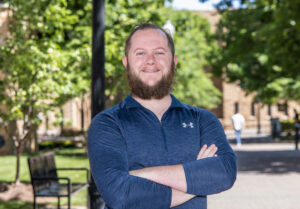

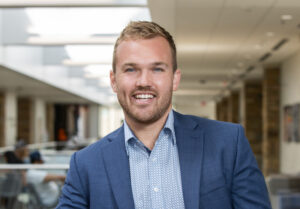


The evolution of artificial intelligence means countless industries are seeing rapid advancements, with 90% of U.S. companies expected to run AI models by the end of 2025, according to JLL. Leading the charge toward integrating AI into the real estate and finance sectors is Cayman Seagraves, Ph.D. and assistant professor of finance in The University of Tulsa’s Collins College of Business.
Seagraves first recognized AI’s transformative potential in 2022 with the launch of ChatGPT, immediately exploring applications for real estate. “Its fluency and flexibility struck me,” he recalled. “Until then, we’d only dreamed of tools that could brainstorm, write code, even analyze data without constant human direction.”
Now, the commercial real estate AI market is projected to reach $732 billion by 2028, growing at 34% annually. Tasks like automated report writing, interactive market analyses and AI-powered agents that deliver personalized investment recommendations are revolutionizing how the industry operates. Seagraves predicts that “2025 is the year of AI agents, autonomous software entities that perceive their environment, plan multistep workflows and execute actions iteratively toward a goal. Their growth across industries is already accelerating.”
These AI agents represent a fundamental shift from passive tools to active participants in real estate transactions. For instance, agents can now monitor dozens of markets overnight, flag properties matching specific investment criteria, prepare preliminary underwriting and draft letters of intent with comparable data – all while professionals sleep. International Data Corporation (IDC) research shows that every dollar spent on generative AI returns $3.70 in value, demonstrating the technology’s immediate ROI potential.
 Seagraves’ research and academic publications are furthering the reach of AI in the industry. His paper “Optimizing Real Estate Portfolios: The Role of AI in Geographic Diversification,” co-authored with Timothy Dombrowski, was presented at the prestigious Concordia Generative AI conference and was published in July in the Journal of Real Estate Portfolio Management. This innovative piece highlights the potential of AI agents and generative AI in advancing data-driven portfolio management.
Seagraves received four best paper awards across 2024 for his research, and his project “Measuring Commercial Real Estate Sentiment with Large Language Models” secured a $17,500 grant from the University of Denver’s Glenn Mueller Real Estate Cycle and Sustainability Fund.
As a sought-after authority, Seagraves has shared his insights at three major events so far this year: the GTAR Commercial Market Update and the ULI Oklahoma panel on April 29 and UTulsa’s own Generative AI & the Research Process workshop on April 30.
Looking ahead, Seagraves has joined with Stace Sirmans and Javad Keshavarz of Auburn University on “Artificially Biased Intelligence: Does AI Think Like a Human Investor?” in order to analyze the limitations and biases of LLMs. His transformative work is paving the way to establishing Collins College of Business as a national thought leader in AI applications to real estate and finance.