





Institute for Robotics & Autonomy
Applied R&D in Robotics and Smart Environments
The University of Tulsa’s Sarah and John Graves Institute for Robotics & Autonomy was founded in September 2024. The institute explores interaction between humans and robots, with an initial concentration on how collaborative robots, or cobots, can help people age in place, in part by improving in-home rehabilitation treatment.
The institute’s research team studies robotics, artificial intelligence, safety, autonomy and human-machine interaction with a goal of using cobots in homes. The Institute for Robotics and Autonomy aims to advance the research frontier for cobots through breakthroughs in fundamental and applied research as well as commercial development.
Our Approach
Research
Evaluate commercial robotic systems and advance their capabilities through fundamental and applied research in mechatronics, mechanical engineering, biomechanics and computer science.
Talent Generation
Generate top-tier talent at all stages of human capital development from undergraduate students, graduate students and postdoctoral associates to meet the growing demand for expertise.
Commercialize
The UTulsa Institute for Robotics & Autonomy is located in a region recognized by the U.S. Economic Development Administration as a tech hub, creating opportunities for public and private partnerships and technological and commercial innovation.
Why Robotics?
Industries across all sectors are rapidly moving toward new forms of automation, increasing the demand for robotic technology, its integration with artificial intelligence and people on the cutting edge of these fields.
$350B Projected global market size by 2032
$42.6B Industrial robotics market in 2024
40M+ Robots sold between 2016 & 2019
$9B Revenue generated in North America in 2023
Research & Projects
Current Projects
Cooperative Robots for Aging in Place
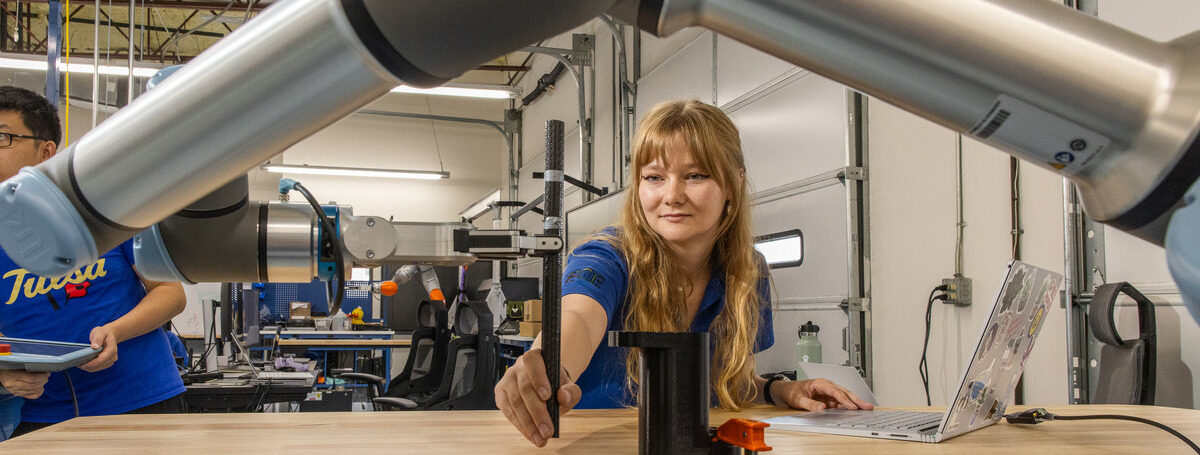
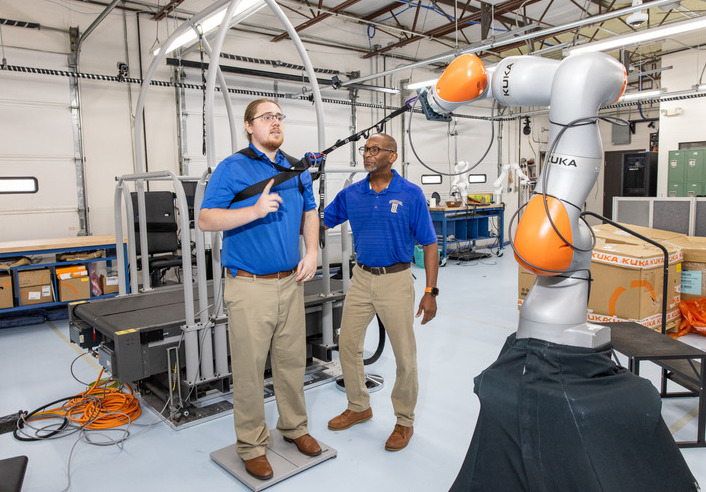
Our current investigations include an institutional review board–approved protocol to evaluate how a Universal Robot, combined with Noraxon electromyography to monitor muscle activity, can assist a sit-to-stand training scheme. Another biomechanical research project examines how a Kuka robotic arm and Bertec force plates can produce robust data to better understand proprioception and balance.
Evaluating Robot Capabilities
We evaluate commercial off-the-shelf robotic platforms for their effectiveness in supporting independent living. Our research includes testing mobility, dexterity, perception, and autonomy.
Developing Advanced Autonomy
Autonomy is critical for assistive robots. Our research explores how robots can adapt their behavior based on changes in the environment and user needs, ensuring they provide reliable and effective support.
Publications
Our team has contributed to numerous journals and conferences, sharing our findings and advancements in robotics.
Collaborations
Community Partnerships
We collaborate with community partners to test our robotic solutions in real-world environments. These partnerships help us refine our technology and ensure it meets practical needs.
Industry Engagement
Our center collaborates with industry stakeholders to translate our research into commercial applications. By engaging with the Tulsa Tech Hub consortium, we aim to bring our innovative solutions to market.
State-of-the-art equipment
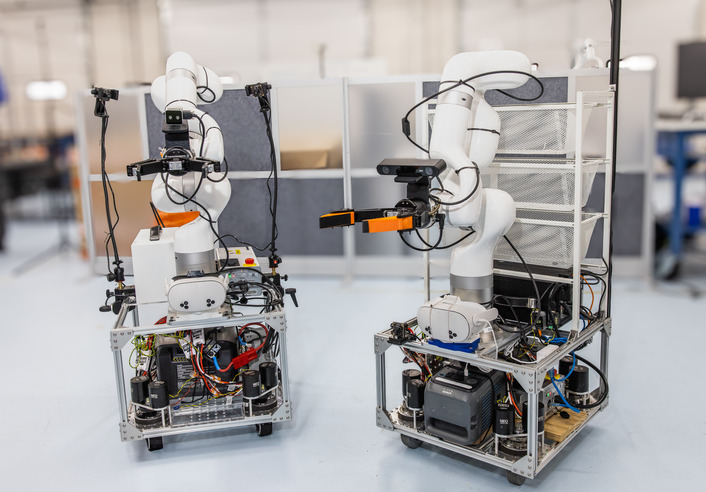
The institute features cutting-edge equipment including:
-
- Dell PowerEdge XE9680 8-GPU cluster server and a Dell PowerEdge R7615 collector
- KUKA LBR iiwa 7 R800 Robot
- KUKA LBR iiwa 14 R820 Robot
- KUKA LBR Med 14 R820 Robot
- KUKA LBR iisy 11 R1300 Robot
- KUKA LBR iisy 15 R930 Robot
-
- UFACTORY X-ARM 6 (UF850) Robot
- UFACTORY X-ARM LITE 6 Robot
- Universal Robots UR5e Robot
- Universal Robots UR20 Robot
- Bertec Fully Instrumented Treadmill v5 (FIT5)
- BTE PrimusRS
- Vention Telescopic Lift Column
- Vicon Vicon Vero Camera
- Vicon Vicon Valkyrie Camera








We are always looking for passionate individuals to join our team. Whether you are a student, researcher, or industry professional, there are many ways to get involved with the Institute for Robotics & Autonomy.
For questions or more information, contact Rose Gamble, Vice President for Research and Economic Development, at 918-631-2988 or gamble@utulsa.edu.