





The U.S. Department of Defense has selected The University of Tulsa’s Alexandra Kingston to receive a Research Collaboration award of nearly $600,000 under the Defense Established Program to Stimulate Competitive Research (DEPSCoR). The title of her project is “Shock Wave Damping Helmets of Snapping Shrimp: Microstructure, Dynamic Responses, and Cellular-Level Protection.” Kingston’s collaborator on the project is Daniel Speiser of the University of South Carolina.
An assistant professor of biological science, Kingston is an expert on the neurobiology and sensory physiology of invertebrates. Her integrative work draws on engineering, neurophysiology and neuroanatomy, materials science, psychology, neuroscience and other fields. The three years of DEPSCoR funding will support Kingston’s continuing research on the specialized, helmet-like armor that protects snapping shrimp (Alpheidae) from neurotrauma caused by their exposure to the supersonic high-amplitude pressure waves they produce with their claws.
“Snapping shrimp are frequently exposed to such shock waves, so the fundamental quest is to understand the mechanisms they have evolved to protect against such assaults,” Kingston explained. Working with colleagues from the University of South Carolina, she found that snapping shrimps’ orbital hoods – helmet-like extensions of the exoskeleton that cover their eyes and brains – are responsible for damping shock waves, making them the first biological armor system known to have such a function.
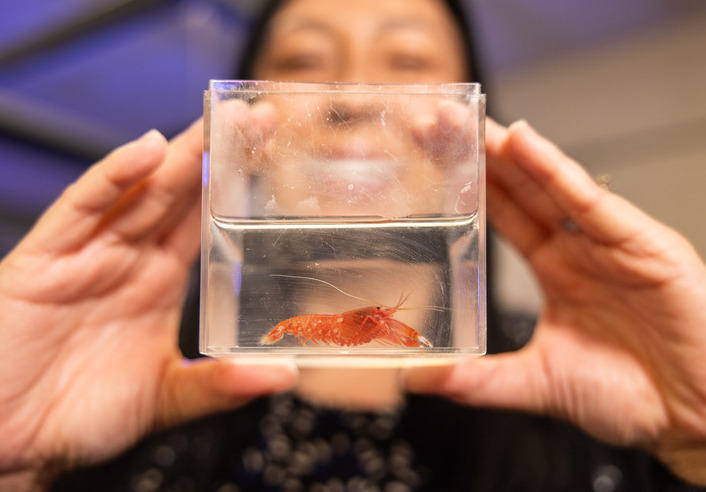
The next stage of the investigation entails learning about orbital hoods’ material structure. To do this, she and Speiser will employ familiar techniques, including transmission electron microscopy (TEM), microcomputed tomography (microCT) and image analysis. “We have also begun using new (to us) approaches, including high-speed schlieren imaging to visualize shock waves interacting with orbital hoods in real time and focused ion beam scanning electron microscopy (FIB-SEM) to image high-resolution, 3D images of orbital hoods,” Kingston added.
One of the most exciting avenues she intends to pursue during the coming three years is the potential application of her findings for humans. Among other groups, soldiers, she points out, are at risk of blast-induced neurotrauma. “But what if there were a way to learn from snapping shrimps’ helmets to design armor systems that protect them?” Kingston asked.
The Kingston Lab addresses fundamental questions on the neurobiology and sensory physiology that guide invertebrate behavior. It is one of several groundbreaking labs in the Department of Biological Science in UTulsa’s Oxley College of Health & Natural Sciences.