

According to the National Brain Tumor Society, approximately 1.3 million Americans are living with a brain tumor. The relative survival rate for people with this notorious disease is only 34.8%, and 18,350 people in this country are expected to die from one of its forms this year alone.
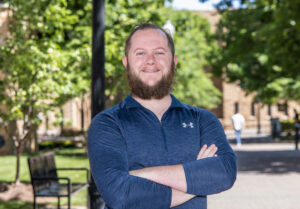
Current treatments for brain cancer usually involve surgical removal of as much of a tumor as possible, followed by radiation and chemotherapy to kill any residual cancer cells. At Oxley College of Health & Natural Sciences, Associate Professors Angus Lamar and Robert Sheaff are leading the charge to improve the potency of chemotherapy and, thereby, patient outcomes. In fact, The University of Tulsa recently filed a patent for their compounds as anticancer agents.
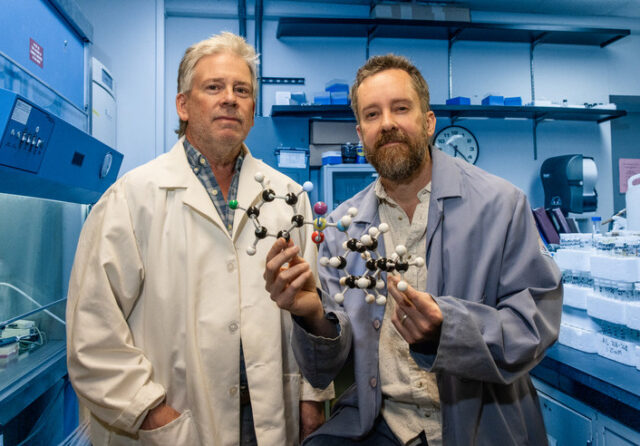
“Chemotherapeutic options are limited because of the heterogeneity of brain cancer cells and the need for these drugs to cross the blood-brain barrier (BBB),” explained Lamar. “In order for a compound to be BBB-permeable, several features of the molecule must be taken into consideration, a fact that makes the design of potential drugs highly challenging.”
New compounds, fresh hope
Several years ago, Lamar and Sheaff began collaborating on the creation of analog compounds that are similar to memantine – a drug used to treat Alzheimer’s that is known to cross the barrier. After developing new compounds, they test them to determine their potential as anticancer agents.
With funding from the Oklahoma Center for the Advancement of Science and Technology, the first step was to create a new organic reaction that enabled them to install sulfonamide functional groups into specific locations of organic molecules. Since then, the two chemistry professors have installed the sulfonamide group into the memantine core to create more than 30 new memantine analogs they predict are able to cross the barrier. Following that work, they tested the compounds for anticancer activity against a glioblastoma cell line, observing cytotoxicity significantly higher than temozolomide, the frontline chemotherapeutic for brain cancer.
Lamar and Sheaff have shared their findings with the scientific community through a number of publications. These include articles in leading scholarly journals such as Organic and Biomolecular Chemistry (2022) and ChemMedChem (2023), a piece that has since been featured on Medicine Innovates. Their most recent paper appeared in Results in Chemistry (2025).
“In the Research in Chemistry article, we documented our work testing compounds as inhibitors of metabolic energy production, which is another way to target cancer,” Sheaff observed. “Our key discovery was that one of the analogs has high selectivity and potency for glioblastoma cells but no observable effect against normal – that is, noncancerous – cells under the same experimental conditions. We are very excited about this being a possible drug that can cross the BBB and target cancerous brain cells while leaving healthy cells unharmed.”
A team approach
As can be seen in the lists of co-authors associated with these publications, Lamar and Sheaff draw on UTulsa students from an array of programs for assistance. In their five most recent publications, they have benefited from the energy and insights of 19 undergraduates and four graduate students.
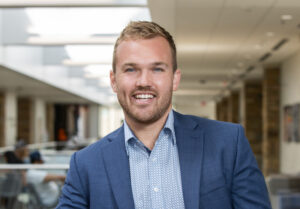
One of the undergraduate researchers who contributed to Lamar and Sheaff’s advances is Garett Ozmer (B.S. ’22). Currently wrapping up his M.D. studies at the UTMB John Sealy School of Medicine and about to begin a three-year internal medicine residency, Ozmer began assisting in Lamar’s lab during his freshman year and continued through to graduation.
Much of Ozmer’s efforts focused on combining polycyclic aromatic hydrocarbon scaffolds with sulfonamide cores for brain cancer research. He was responsible for calculating the ratios for each agent in a reaction, adding the agents to test vials, running the reactions, purifying the end products and quantifying their weights and determining the reactions’ success via H NMR analysis.
“I absolutely loved contributing to this research,” said Ozmer. “In addition to becoming well-versed in many organic chemistry lab techniques, during my senior year, I presented findings at the spring 2022 American Chemical Society conference in San Diego and I published three scientific papers that drew on my investigations, an achievement that put me at a big advantage when applying to medical school.”
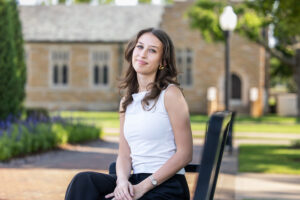
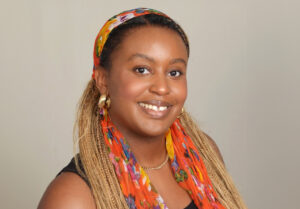
Now in her third year of the M.D. program at the University of Oklahoma, Reema Moussa (B.S. ’23) was similarly impacted by her time working on UTulsa’s brain cancer research. During summer 2022, as part of the Tulsa Undergraduate Research Challenge, Moussa and other students synthesized approximately 30 memantine analog compounds.
“This experience was transformative for me in multiple ways,” she recalled. “I had never worked in a lab outside of class time, and it was my first opportunity to do something technical that required more than textbook knowledge. At the start, I did not have a lot of confidence in my abilities. However, from my first day in the lab, I felt supported and encouraged to ask questions and jump right in.”
Reflecting further on that pivotal experience, Moussa is thankful for the guidance she received from Lamar on how to present research in a large setting in a way that is both engaging and thorough, including at the same ACS conference as Ozmer. “I have, since then, shared my investigations at regional and national medical science conferences where, while the topics have been different, I still use the same structure and skills Dr. Lamar taught me.”
Further investigations on the horizon
Looking ahead to next steps, Lamar and Sheaff plan to seek funding to support future research and student training, which will involve moving beyond cell-based – in vitro – studies to investigate the compounds in living systems – in vivo. “Based on those results, we may need to modify the compounds to be more effective in a living system,” noted Lamar. And, added Sheaff, “we will definitely be looking toward conducting more in-depth study of the exact mode of action of our compounds, which might also lead to the synthesis of an even more active compound.”
Take your place at the forefront of life-changing science and health care
Faculty across Oxley College of Health & Natural Sciences open doors to leading-edge discovery. Let us know your interests and goals, and we’ll help you find the perfect research opportunities.