




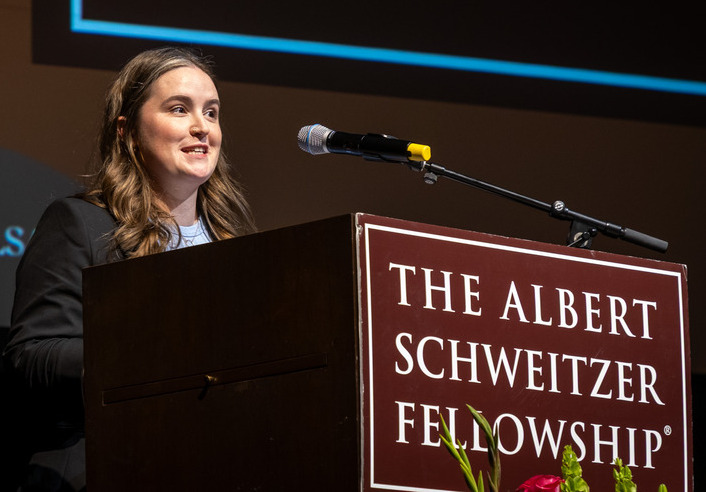
The Tulsa chapter of the Albert Schweitzer Fellowship (ASF), which is based at The University of Tulsa’s Oxley College of Health & Natural Sciences, has a new director: Emma Morris. Before coming on board, she served as an urban strategist with the City of Tulsa, a fiscal policy and health care analyst with Oklahoma Policy Institute and several other related positions that focused on working with a broad range of stakeholders to enhance individual and community life.
Here is a question-and-answer introduction to Morris and why she’s such a great fit for her new position.
What are your main functions as ASF Tulsa chapter’s director?
Much of my work centers around our Fellows and Fellows for Life (FFL). With Fellows, I brainstorm and problem-solve as they implement their community-based projects, and we work together to design monthly leadership trainings and experiences. In the fall and early spring, I recruit new applicants for the next cohort and I am always seeking opportunities to stay in touch with and provide engagement opportunities for our FFL.
Everything I do relies on partnerships, so I also get to meet and learn from organizations across Tulsa and eastern Oklahoma to better understand our communities’ health needs. The Tulsa chapter depends entirely on local funding to do our work, so I spend a good deal of time sharing the ASF’s story with current and prospective supporters.
What inspired you to forge a career in community wellness and development?
I was born and raised in Shawnee, Oklahoma, and the experience of growing up in a small, close-knit place truly shaped my sense of self and community. From a young age, I spent a lot of time at Shawnee Little Theatre, where I learned about the value of being in relationship with folks who think differently than I do. I also experienced the power of creativity when it comes to community-building.
When I wasn’t at the theatre, I was usually at my grandpa’s dental office. My grandma would pick my sisters and me up every day after school, and we’d spend the afternoons listening to the whir of his tools and exploring the rest of the building, which housed a physician’s office, a lab and a community-based nonprofit focused on addiction prevention. My interest in community health was formed in that building, where I learned firsthand the importance of seeing health as more than just what happens in an exam room.
How about your professional experiences prior to joining the Tulsa ASF?
I think of my professional experience as a three-legged stool: health policy, leadership development and community engagement. With the Oklahoma Policy Institute, I worked to advance bipartisan health policies at the state Capitol and with state agencies – like the expansion of Medicaid postpartum coverage from two months to a full year. On the leadership front, my social entrepreneurship fellowship with The Mine and my years as a student in OU Tulsa’s MPA nonprofit administration program taught me how to ask insightful questions and how to reflect on my own experiences and help others do the same.
Community engagement has been at the center of each role I’ve held, challenging me to ask new questions, find new perspectives and braid those together into forward momentum. Arcing over everything, my time as a case manager in Oklahoma’s prison reentry system shaped the way that I see people and the role we each play in crafting a community. That experience helped me learn how to better understand people and their motivations, and it deepened my capacity for empathy.
When did you first learn about the ASF?
I learned about the ASF not long after my husband and I moved to Tulsa four years ago so that he could attend medical school. He’s now a resident physician in the OU Family Medicine residency program. During Alec’s time as a student, he became a Tulsa Schweitzer Fellow. I watched in amazement as he built leadership skills, expanded his Tulsa network and partnered with another Fellow to strengthen the STEM and medical education pipeline for Tulsa students. That was my first inkling that I really needed to get involved in helping grow this outstanding Fellowship opportunity for others.
Any highlights thus far you’d like to share?
My favorite moments center around our Fellows, like when a Tulsa Fellow cochaired a national gathering for 250 Fellows nationwide or when a new partnership idea to meaningfully enhance access to care came out of a recent FFL gathering or when a Fellow started his project and reported that the participants were eager to set goals and come back the next week.
And at a recent press conference, Tulsa Mayor Monroe Nichols announced the creation of the city’s first Office of Health and Well-being, led by Senior Advisor for Community Health Dr. Jabraan Pasha, who also serves on the ASF Tulsa advisory board! Looking around that room, which was full of people from Tulsa’s academic institutions, hospital systems, community clinics, foundations, insurance providers and the health department, it was hard not to see so many connections to ASF Tulsa. It’s not a surprise, but rather a confirmation, that our community sees the impact of ASF Tulsa and that there are so many good people doing good and innovative things together in our city and region.
What’s on your radar as ASF Tulsa’s new director?
Rachel Gold launched the Tulsa chapter nearly 10 years ago, and I’m lucky to still have her right next door as the executive director of ASF’s national office. In addition to maintaining the standard of excellence Rachel set, I plan to expand opportunities for involvement with Schweitzer programming, develop new relationships with stakeholders, find new ways to engage our community of more than 100 FFL in Oklahoma and beyond and set us up for even more success in the years to come.
Your role as ASF Tulsa director sounds really fulfilling. But what makes you tick outside of work?
One perhaps surprising outcome of my time so far with ASF Tulsa has been the opportunity to re-prioritize my personal creativity. Outside of work, I dance with Oklahoma Movement and spend time creative writing. My favorite way to reenergize is to stay outside as often as I can. Whether in the Arts District or on the River Parks trails, I love exploring all the wonders that Tulsa has to offer!
Learn more and get involved
Founded in 1940 by the physician and humanitarian Dr. Albert Schweitzer, ASF is a leadership development program for graduate and professional studies students. With 10 chapters across the country, including Tulsa, ASF provides mentored experiential learning opportunities for fellows to grow their skills, vision and experience in shaping community-based initiatives that improve the health of underserved populations.
Would you or someone you know make a great ASF Fellow? Visit asftulsa.org/become-a-fellow/ or email emma-morris@utulsa.edu.