


Close your eyes and say the word “laboratory.” What image does your mind conjure? For many of us outside the world of science, what appears is a shadowy chamber filled with bubbling beakers, glowing liquids and steampunk machinery emitting showers of electrical sparks. And all of this is presided over by a feverish individual sporting a vast, unruly hairdo.
While such vintage Hollywood-inspired visions are alluring, most scientists today operate in settings that are rather less zany but no less fascinating. A case in point is Sima Jonusaite, an assistant professor of biological science who joined The University of Tulsa’s Oxley College of Health & Natural Sciences in January 2025.
Jonusaite’s research examines how invertebrate animals adapt at a cellular level to changes in their environments that are occurring rapidly due to climatic factors or human activities. “A clean, well-equipped and welcoming lab is essential both for furthering my research as well as for offering students meaningful opportunities to develop their knowledge, skills and confidence,” she commented. “Since arriving at UTulsa, my colleagues and our chair, Mark Buchheim, have been utterly supportive in accommodating my needs for my lab as well as for upgrading instruments in our core facility.”
Setting it all up
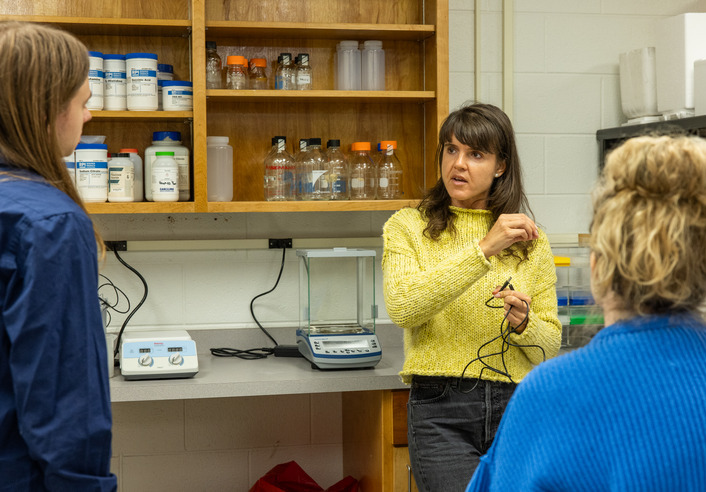
In addition to teaching and supervising students during her first year at UTulsa, Jonusaite focused a good deal of her time and energy on setting up her lab. Shortly after arriving, Jonusaite was handed a set of keys to two connected rooms on the second floor of Oliphant Hall. Both were furnished with benches, shelves and cabinets. “The only pieces I needed to request were some high-rise chairs, which Dr. Buchheim had delivered the same day I requested them,” Jonusaite recalled. Her lab also contained several small pieces of equipment, including dissection microscopes, bench-top centrifuge, incubator, sonicator and vortex mixer.
After seeing what was available in her lab as well as the equipment and facilities in the Department of Biological Science, Jonusaite prepared a list of essentials she would need. These included chemicals, plasticware, pipettes, shakers, dissection tools, pH meter, computer and a precision balance, which she purchased using start-up funds from the university.
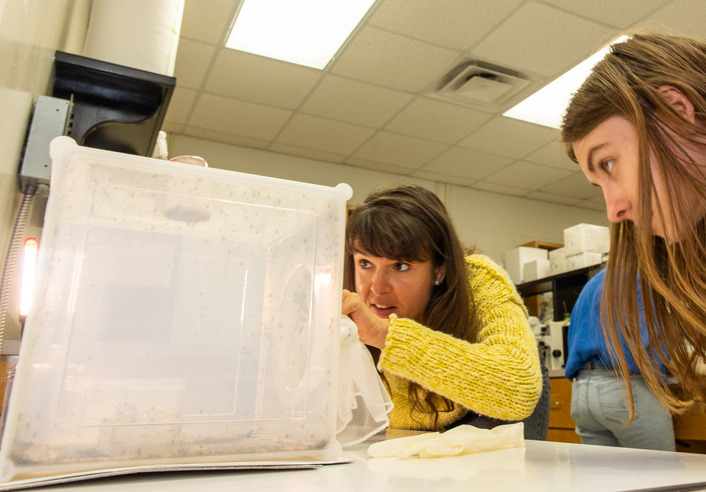
“My current research elucidates how the functions of organs, such as the kidney, help aquatic larval and terrestrial adult-stage mosquitoes cope with changes in the availability of environmental and dietary salt and water,” she explained. To facilitate these investigations, one of her first equipment orders included mosquito cages, allowing her to quickly establish a colony.
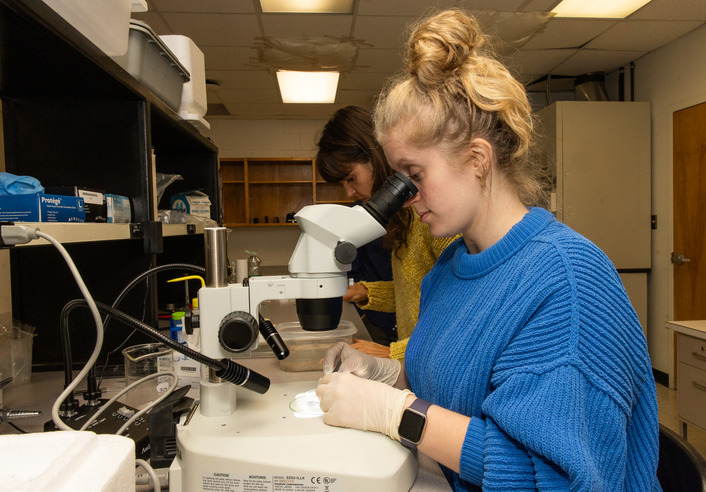
The molecular biology investigations involved in Jonusaite’s work include quantifying gene expression in various samples using a qPCR machine. Originally purchased in 2005, the department’s unit ran on a Windows system that was no longer supported. “Dr. Buchheim immediately understood my need and ordered a new qPCR machine,” she said. The department also covered the cost of repairing its confocal laser-scanning microscope, which is crucial for her research.
Already buzzing
Jonusaite expects her lab to be completely built and fully operational by the end of 2026. In the meantime, she is conducting experiments involving two major projects.
“Much of the data for one study was collected by undergraduates,” Jonusaite commented, “some of whom worked with me last summer as part of the Tulsa Undergraduate Research Challenge (TURC). Students bring such great energy to the lab and their contributions are vital.”
Emmett Withee, a sophomore from Morehead City, North Carolina, majoring in applied mathematics with a minor in biomathematics, worked in the Jonusaite Lab in fall 2025 and is continuing on this spring. “Most of my time involved imaging cells with the electron microscope,” he said. For Withee, the main benefit “comes from talking with Dr. Jonusaite and hearing the process that goes into developing research and being a successful scientist.”
Jonusaite plans to add graduate and post-doctoral students to her lab’s team. She is also confident the preliminary data collected thus far will feed directly into grant proposals and applications for external funding that will keep her lab buzzing for many years to come.
Energize your future
Across Oxley College, faculty are spearheading research and ensuring students have ample opportunities to immerse themselves in the work. Help us expand the frontiers of health care and science!