





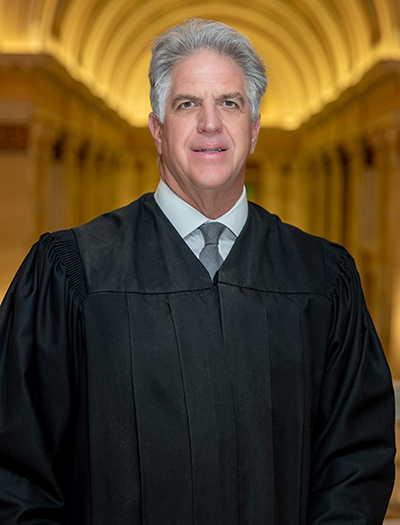
When Judge James R. Huber (J.D. ’93) learned he had been elected to the American Law Institute, his first reaction was simple.
“I was very honored,” he said. “A little surprised, to be perfectly frank.”
The American Law Institute is composed of judges, practicing attorneys and legal scholars who work to clarify and bring cohesion to the law nationwide. Members are nominated and selected through a formal review process. For Huber, who serves on the Oklahoma Court of Civil Appeals, the election represents national recognition and a continuation of a career rooted in Tulsa and in The University of Tulsa’s College of Law.
When Huber was considering law schools, he applied to several across the country, but trusted mentors in Tulsa gave him direct advice.
“They told me if I wanted to live in Tulsa, go to TU,” he recalled. “Because of the community.”
That guidance shaped not only where he studied, but where he built his life and career.
Huber met his wife, Julie Huber (J.D. ’93), on the first day of law school at the former Metro Diner on 11th Street. They graduated together and then studied for and passed the bar the same year.

“I distinctly remember going up to the law school and looking on the door for the list,” he said. “It was a big relief.”
The experience, he said, was demanding but formative: “Law school’s a marathon. It’s not a sprint. You just have to grind and persevere.”
During law school, Huber interned at the Tulsa County District Attorney’s Office, where he began building courtroom experience and professional relationships that would later shape his career. He describes UTulsa Law less in terms of single moments and more in terms of community – classmates navigating the challenge together and a legal network that remains interconnected decades later.
Huber spent 27 years in private practice. He opened his own firm in 1995 and later served as managing partner of Collier and Huber, representing businesses and individuals in employment and commercial litigation matters. His practice spanned state and federal courts and covered a wide range of subject areas.
“I was in bankruptcy court a lot on behalf of creditors for years,” he said. “But I also tried a murder case. I tried commercial litigation jury trials. I tried real estate jury trials.”
That breadth, he believes, shaped his perspective.

When he was appointed as a special judge in Tulsa County in 2019 and later served as district judge and chief judge of the Family Division, he entered an entirely new area of law. In 2023, Gov. Kevin Stitt appointed him to the Oklahoma Court of Civil Appeals. He was retained by Oklahoma voters in 2024.
Now, as an elected member of the American Law Institute, Huber sees an opportunity to contribute from that broad base of experience.
“It’s not rewriting the law,” he said of the ALI’s work. “It’s really designed to bring some cohesiveness to the law amongst the states.”
He hopes to bring what he calls “practical common sense” to the organization’s work, informed by decades in the courtroom and on the bench.
For current UTulsa Law students, Huber’s advice reflects the path he has taken.
“I personally think it’s important to practice law before you become a judge,” he said. “A little gray hair helps.”