






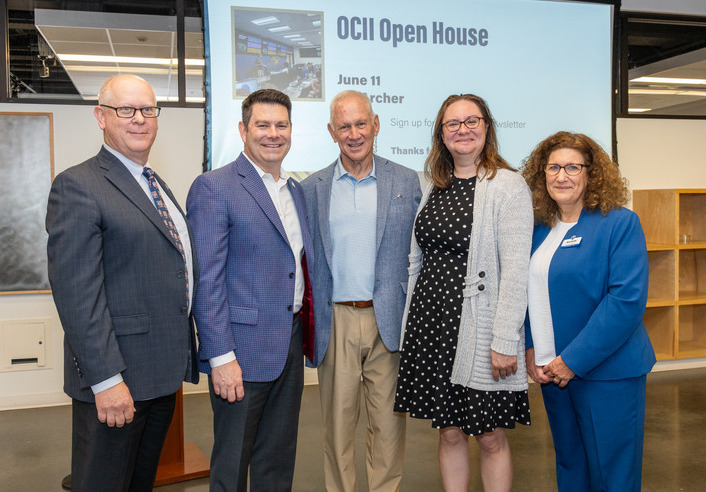
The Oklahoma Cyber Innovation Institute (OCII) at The University of Tulsa is expanding its physical footprint and its impact on the local community. The center’s new home at 101 Archer in downtown Tulsa is strategic and significant because it places the institute in the city’s technology hub. There, OCII will continue to focus on its three pillars: cyber education, small business cybersecurity services and autonomous vehicles.
OCII Executive Director David Keely spoke about the move during an open house and ribbon cutting ceremony on Thursday, June 11.
“We will work with our sister institutions, collaborate with partners like Black Tech Street, universities and Tulsa Innovation Labs, to help move this region into the future, in terms of cybersecurity and security of autonomous vehicles – that’s drones,” said Keely, “and to support small businesses, who often can’t afford cybersecurity services.”
He explained that the world around us is changing rapidly due to technology like artificial intelligence, robotics and more. OCII aims to solve imminent and future problems associated with these tech advancements.
“There has to be a safety factor associated with that,” he said. “People need to know that the infrastructure is going into place to keep them safe and secure.”
UTulsa and city leaders attended the open house event, including Tulsa Regional Chamber Executive Vice President & Chief Operating Officer Justin McLaughlin. He noted that Tulsa businesses, large and small, face similar threats in the increasingly challenging cyber environment.
“The stakes today could not be higher,” McLaughlin insisted. “The cost of global cybercrime is estimated to be $10 trillion annually, making it one of the greatest economic threats facing businesses, governments and institutions around the world. Every day, organizations confront increasingly sophisticated attacks that threaten operations, compromise sensitive information and undermine confidence in the digital systems that we all rely upon every day.”
He said OCII’s presence represents an investment in the future of Tulsa’s economy, workforce and competitiveness. With the institute functioning in the heart of Tulsa, just minutes away from the UTulsa campus, it allows the city to meet the latest cyber obstacles while positioning itself as a regional tech leader.
“UTulsa already has earned a well-deserved reputation as one of the nation’s premiere centers for cybersecurity education, research and innovation,” said McLaughlin. “Oklahoma Cyber Innovation Institute further solidifies that standing and sends a powerful message: that Tulsa intends not only to participate in the cyber economy, but to help shape it.”
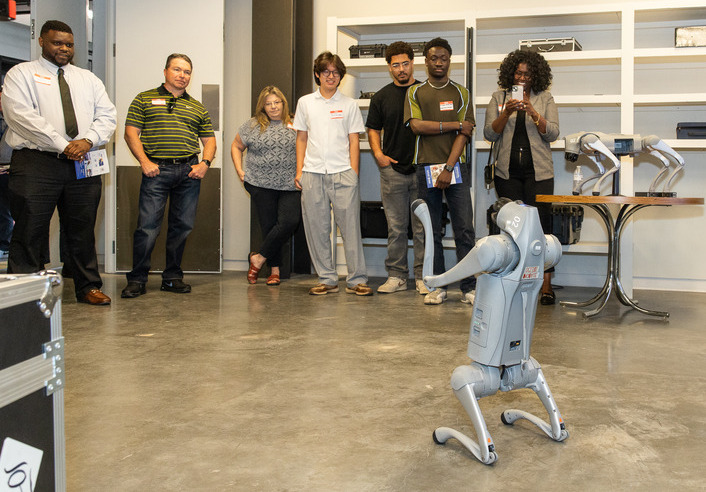
Guests who attended the open house enjoyed a guided tour of OCII’s new space, including short demonstrations of applied cybersecurity services, the cyber range and labs featuring drone and robotic systems. While the robotic dogs stole the show in the Autonomy Lab, Smart City visitors watched a drone hijack demonstration in a lab that’s built to simulate cyber crises that could happen in a large city, such as electromagnetic interference of devices.
Key partners of OCII include the George Kaiser Family Foundation and Tulsa Innovation Labs, alongside managing multimillion-dollar research projects for the National Science Foundation, U.S. Department of Defense and U.S. Department of Commerce. In addition, OCII is supported in part by an American Rescue Plan Act (ARPA) grant that was awarded to the State of Oklahoma and administered by the Oklahoma Center for the Advancement of Science and Technology (OCAST). Learn more about what the institute has to offer, including educational resources for K-12 students, at utulsa.edu/OCII.