


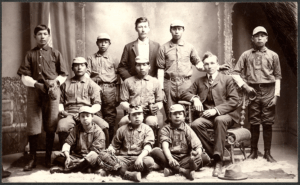
In 2023, author and photographer Adam Forgash discovered a series of several thousand antique glass photo negatives in a storage unit sale in New York. Eight months later, Forgash discovered an envelope tucked away between two of the glass negatives advertising Sydney Joseph Tyler’s Photography Studio in Afton, Oklahoma.
Curiosity piqued, he reached out to The University of Tulsa’s Mary F. Barnard Professor of Nineteenth-Century American History Kristen Oertel. “He just emailed me out of the blue and said, ‘I found these glass negatives at this flea market and I thought they were really beautiful, so I bought them,’” recalled Oertel. “‘Do you think they’re as significant as I think they might be?’”
Forgash sent the first batch of photographs to Oertel, who noted that they appeared to be taken in the 1920s and 30s. “What struck me was how many different kinds of people were represented by the photographs,” she said. “I think we have this impression of early 20th-century photography being of only middle- and upper-class white families who had the money to sit for a photography session. Tyler seems to have gone out of his way to capture every kind of person who was traveling and living along Route 66.”
Through his own research, Forgash discovered that Tyler had a diverse clientele, including Black, Asian, Latino, Indigenous and mixed families. At the time, Afton was a hub of activity, and the surrounding regions brought a lot of tourism to the town. Tyler’s studio was located on what would eventually become part of America’s famous Route 66, undoubtedly contributing to his wide range of clients.
“Although the photo studio was in Afton, this is really a story about the travelers of the Mother Road,” said Forgash. “Most of the photographer’s subjects were everyday travelers passing through the region, making this collection a unique and unseen glimpse into the history of Route 66, northeast Oklahoma, and the people and cultures that shaped the region.”
Oertel, who also serves as faculty associate director of UTulsa’s Helmerich Center for American Research, contacted the director, Billy Smith, who verified the significance of the photos. “Then we reached out to the Oklahoma Center for the Humanities and asked if they would be interested in an  exhibition,” said Oertel.
The exhibition, “Faces of the Mother Road: The Last Portraits of S.J. Tyler,” opens at 101 Archer during the First Friday Art Crawl on Jan. 2, 2026, kicking off the Route 66 centennial. The show will spend two months in Tulsa before hitting the road. “The hope is that with this exhibition patrons will recognize their ancestors, because we still don’t know who most of these people are. They could have been traveling on Route 66 and stopped for a night to capture the moment on film or were people who lived in northeast Oklahoma.”
Beyond the personal connections, “Faces of the Mother Road” will also show viewers a side of Oklahoma that they’ve never seen. “I think this exhibition will open up a window to a past that most Oklahomans didn’t realize existed,” said Oertel. “There’s always been an Indigenous presence, and the multiplicity of races and ethnicities in these photographs provides a rich and complicated picture of the past.”
The exhibition is free and open to the public. The First Friday opening is from 6 to 9 p.m. Jan. 2 at UTulsa’s 101 Archer building in the Tulsa Arts District.