






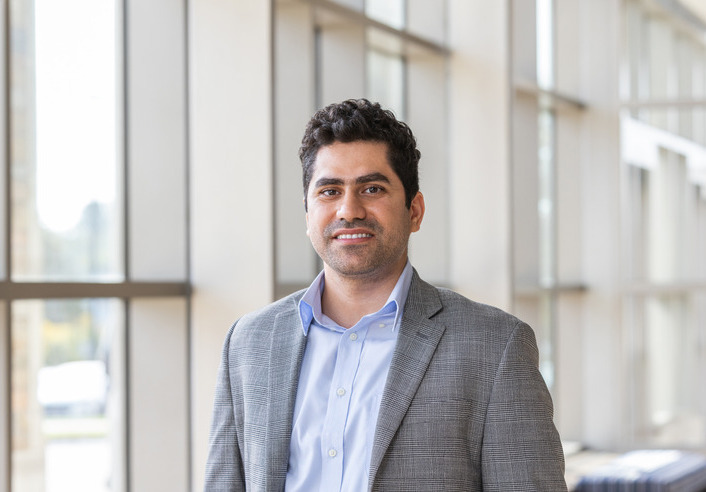
Assistant Professor of Computer Science Mahdi Khodayar, Ph.D., has been awarded a U.S. National Science Foundation grant for his project titled “UTILITARIANS: Multi-Agent Context-Aware Human-in-the-Loop Strategies for Market Participants in Transactive Energy Systems.” Khodayar’s project focuses on transforming solar-powered electricity through how it is produced, shared and consumed with the assistance of artificial intelligence.
The growing switch to solar-powered electricity or other renewable sources provides opportunities for advancing sustainability. A growing number of “prosumers,” or households and businesses that produce and consume energy, can generate their own electricity with solar panels. However, this increase also brings new technical and economic challenges: The power grid must handle these new demands with varying weather conditions and participant behaviors in mind. Therefore, traditional optimization models cannot sustain themselves, and AI could effectively fill in the gaps.
“The future of energy is no longer about large power plants supplying electricity to passive users,” Khodayar explained. “It is moving toward a world where households, businesses and communities act as both producers and consumers of energy.”
Khodayar’s philosophy is rooted in the belief that artificial intelligence should enhance human understanding rather than replace it. He designed the project’s framework to ensure human oversight remains while AI handles the complex, data intensive tasks.
“In practical terms, the system learns how aggregators and prosumers should bid in local energy markets, how to form fair and profitable trading strategies and how to ensure that the physical constraints of the power grid are respected,” he explained.
Locally, this solution will help Oklahoma communities, powering homes and businesses with renewable energy and reducing energy costs. It will also give these communities the opportunity to sell excess energy back to the grid, fostering community participation. On a global scale, this project will guide the further development of transparent and adaptive energy trading and frameworks. The AI integration can empower developing countries with self-efficient electrical grids, making it a suitable solution for grid reliability.
Khodayar emphasized that this grant was supported by a strong foundation of innovation, collaboration and academic excellence. UTulsa’s College of Engineering & Computer Science and Tandy School of Computer Science offered the space for him to further his AI power systems and infrastructure research. Since joining the university, he has been recognized for being among the top 2% of researchers worldwide, according to Stanford University and publisher Elsevier.
“One of our broad focus areas is contributing to a sustainable environment for the 22nd century using powerful computing models such as artificial intelligence. An AI solar-powered integration project is a key component of that vision,” said Tandy Chair of the School of Computer Science Yi Qian, Ph.D.
“I have been able to mentor both undergraduate and doctoral students who directly contribute to advancing this research,” Khodayar said. “The university’s recognition of faculty achievements, including the Zelimir Schmidt Award for Early Career Research, has been a powerful encouragement to continue pursuing high-impact, federally funded work that enhances UTulsa’s leadership in artificial intelligence, computer science and energy systems.”