

Founded in 1992 by Professor Emerita Teresa Valero, Third Floor Design has worked with more than 250 art organizations and social service agencies across seven states, providing pro-bono promotional and advertising materials to support social justice causes and the region’s thriving artistic community. This year’s cohort of Third Floor Design students spent the year making their mark with cultural institutions around Tulsa.
The University of Tulsa’s student-operated graphic design firm worked with nonprofit organizations including the Spotlight Theater (now the Riverside Studio), the Tulsa Shakespeare Company, the Oklahoma Visual Arts Coalition, SheBrews, the John Hope Franklin Center for Reconciliation and the Tulsa Preservation Commission. Students also met with multiple Route 66-related projects ahead of this year’s Mother Road centennial.
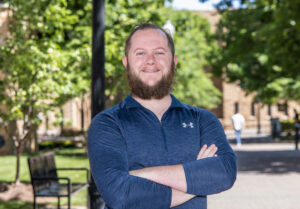
For art junior Caleb Bovell of Belton, Texas, getting to work with so many different Tulsa organizations allowed him to connect with the community. “I’ve loved being able to contribute to the work they’re doing for Tulsa,” he said. “It’s also really cool getting to see your work in downtown windows and know that you’re making real work for the real world.”
Bovell and his fellow students work with multiple clients each semester, taking turns rotating through the different roles of a graphic design team: the main point of contact, the lead designer and the presenter. This allows them to gain professional experience in project management, client communication, scheduling and production. The team goes through several rounds of meetings and design phases, looking at each project holistically and giving their input as they define a project brief.
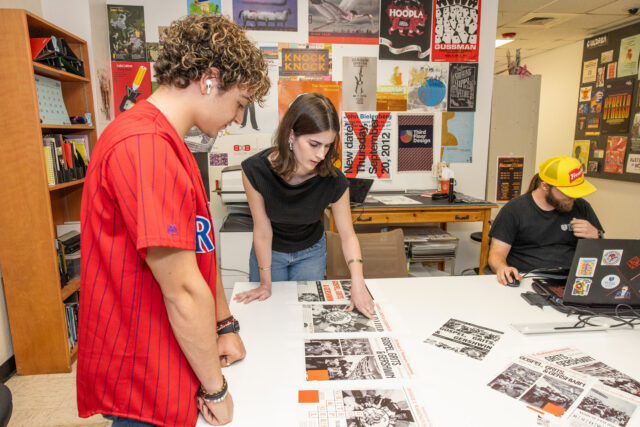
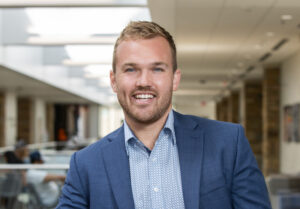
After each student pitches their designs to the client, their individual concepts are combined into one as the project moves forward. “They are so excited to be working in the model of a real design studio,” said Professor M. Wright, creative director of Third Floor. “It gives them the opportunity to work on long-term team-based projects, which isn’t always possible within the traditional classroom structure. Third Floor generates a very supportive team dynamic—they are always excited when one of their peer’s concepts is chosen.”
Holding meetings with clients has given Bovell an excellent opportunity to develop his professional portfolio. “Being a part of Third Floor has provided me with a wide variety of work experiences that will help me in the future,” he said. “It has connected me with many different clients devoted to doing work in the community, and I’ve learned how to work with them to achieve their goals.”
These latest clients connected the students to Tulsa’s history, as they absorbed the visuals of the city – from the old neon lights downtown to the unique architecture of the Riverside Studio designed by famous American architect Bruce Goff. The students took time to dig into Goff’s sketches, his architectural vision and even his handwriting as they worked through the visual development of Riverside Studio’s new branding and website redesign. The studio will use the rebrand to unify the visual identity for its current and future programming, and to help the venue as it seeks funding for architectural preservation and restoration.
“The new branding will not only pay tribute to Goff’s work, but it will support the theater as they open up the space to even more artists and performers from across the city,” said Wright. “This is a unique opportunity to not only connect to the design legacy of Tulsa but to partner with this cultural landmark and contribute to their future as they enter their second century.”
Third Floor students have received praise from the nonprofit community for their work, and accolades from professional design competitions. This spring, eight students received awards from a national jury in the Art Directors Club’s annual Graphex competition for projects they created in Third Floor Design and Wright’s Typography Studio course. Their work for the Spotlight Theater, Booker T. Washington Foundation, and a rebrand of Third Floor itself, as well as a risograph-printed poster series, will be showcased alongside award-winning projects by Tulsa’s leading design agencies.
While Third Floor dives into the city’s history, it’s also playing a part in shaping Tulsa’s future visual identity. Projects like the rebranding for the Tulsa Preservation Commission offer the chance to create a new visual voice for the city after the previous logo’s 50 years of use. Based on Tulsa’s iconic Art Deco architecture, the commission’s new visual identity will have a lasting presence in the civic life of the city.
“Students are eager to work on projects that feel meaningful, where they are designing something that has a real impact,” said Wright. “That’s the reason designers get into this field. You’re not just creating for yourself.”
UTulsa’s School of Art, Design & Art History provides an exceptional foundation for students to delve into the visual arts. Visit campus and stop by historic Phillips Hall to learn more. Don’t forget to check out the latest exhibition in Alexandre Hogue Gallery while you’re there!