


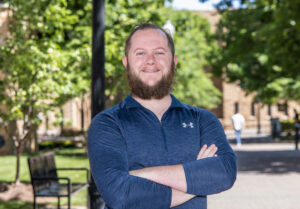


“The world is a possibility if only you’ll discover it,” said American writer and Oklahoma native Ralph Waldo Ellison. His words open Applied Associate Professor Quraysh Ali Lansana’s new book, “Ralph Ellison: More Than Invisible,” part of the “I Am Oklahoma Children’s Series,” published by the Oklahoma Hall of Fame Press, which works to provide free books to all schools and public libraries across the state.
This book has a special significance to Lansana, who has published three prior books of children’s literature. “More Than Invisible,” will be the first book he has published with the aid of Tulsa Undergraduate Research Challenge students; Brianna Burk (B.S. ’25) and senior Isaac McGill, who is majoring in math and sociology, are credited on the project.

For Burk, who majored in psychology, learning about the famous author and the experiences of other Black Oklahomans in the early 20th century was eye opening. “I always knew that I wanted to be involved in writing,” she said. “I love the process of creating stories, and it is a privilege to be able to tell someone else’s story.”
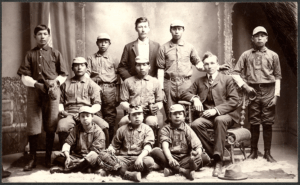
Ellison’s story began on March 1, 1914, in Deep Deuce, a vibrant – but segregated – Oklahoma City neighborhood. Throughout his life, Ellison developed a love of photography and music, and eventually received a scholarship to the music school at the Tuskegee Institute in Alabama.
Ellison re-joined the Merchant Marines in early 1945 but became sick. He and his wife, Fanny, moved to a farm in Vermont in a bid to improve his health. There, Ellison would write the line, “I am an invisible man.” This was the creative spark that would develop into Ellison’s most famous novel, “The Invisible Man,” which is considered one of the great American classics.
Burk was personally drawn to the “Invisible Man” author’s photography. “Some of his photos were very calming, peaceful and relaxing while others were more chaotic,” she reminisced. “I thought it was beautiful to have such a creative mind that was not only able to write but capture an entire story in one photograph.”
Ellison’s interest of photography developed from a young age. “More Than Invisible,” describes the moment that he found his “favorite treasure,” a large photo lens in an alley that he used to burn holes in newspapers or imagine that it was a telescope or magical lantern. As an adult, Ellison would use photography as another creative outlet – to document his surroundings or take notes for his writing. “He had more than one way of telling a story, and photography, music and art are other ways of telling a story. All this fed into his writing,” said Burk, who felt privileged to be able to see the connection between the mediums.
For Burk and McGill, their work on “More Than Invisible” is their first publication credit. “It was an honor for me to have two students who worked with me listed as associate editors of a book,” said Lansana, who will soon begin a statewide tour to promote the book and the life of Ralph Ellison.
“Ralph Ellison: More Than Invisible” launches Thursday, Oct. 16, at 6 p.m. at the Thomas K. McKeon Center for Creativity, hosted by the Center for Poets and Writers at OSU-Tulsa.