


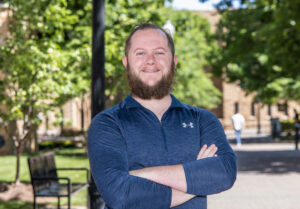



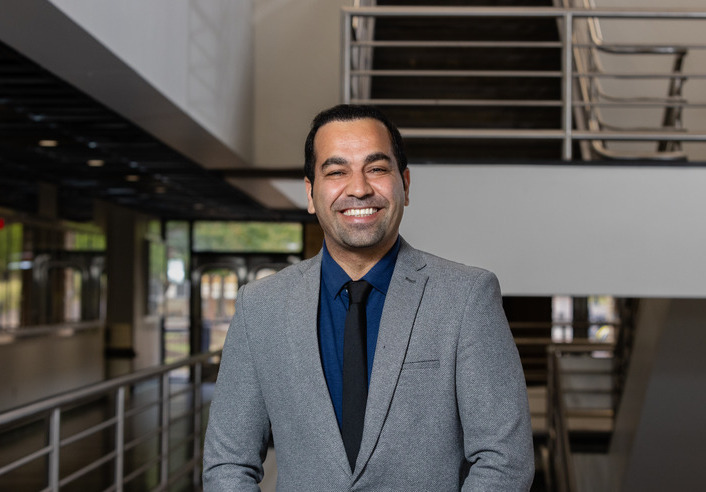
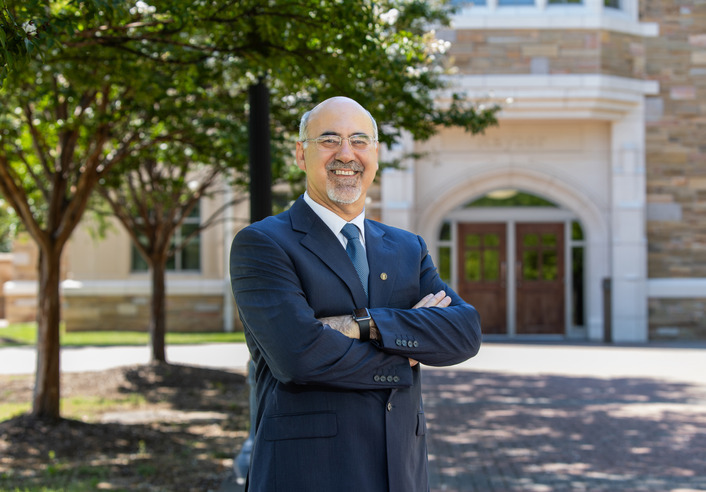
A research team in The University of Tulsa’s College of Engineering & Computer Science is partnering with the U.S. Army on a research initiative to develop a safer, lighter and more durable battery-powered solution for soldier gear and uniforms. Leading the project is Ahmad Amiri, Ph.D., assistant professor of chemical and mechanical engineering. Co-principal investigators are Andreas Polycarpou, Ph.D., dean of the college, and Jacob Meyer, Ph.D., vice president of technology at ATSP Innovations.
“Our joint team brings together expertise in materials science, battery technology and advanced polymer manufacturing to make this next generation of energy storage possible,” Amiri explained.
He said the grant was a result of years of foundational research and a strong record of innovation among the team in advanced battery materials. Each team member has worked extensively on structural and low-temperature batteries through experience at NASA, the U.S. National Science Foundation and U.S. Department of Defense projects.
“We proposed a concept that not only advances battery safety and performance but also recaptures how energy can be integrated into wearable systems. This grant was awarded based on the technical innovation, feasibility and strong interdisciplinary expertise of our team,” Amiri added.
With its funding from the Army, the work aligns with the Pentagon’s priorities in advanced materials and microelectronics. This technology can be applied in multiple sectors, ranging from defense and aerospace to consumer electronics and medical wearables. Once the prototype phase is completed, the team plans to scale up production in collaboration with the Army’s research centers and industry partners.
On this achievement, Amiri said that this grant is deeply meaningful. He said that UTulsa’s Russell School of Chemical Engineering has given him ample support and the perfect environment for his research efforts. He thanked his doctoral students, Akif Rahman, Hossein Shahali and Shahnewaz Khan, for their dedication and creativity, and ATSP Innovations for its role in bridging academic research with industrial applications.
“Professionally, this project validates our team’s vision and the university’s growing role in advancing next-generation energy technologies,” Amiri said. “Personally, it reinforces our passion for solving practical, high-impact problems that can directly benefit people, from improving soldiers’ safety and endurance to enabling more sustainable energy systems.”
On advice for those inspired by his research, Amiri emphasized that all effort will eventually pay off despite challenges: “Stay focused on your goal and keep pushing forward, even when the path feels uncertain. Research can be challenging and unpredictable, but every obstacle teaches you something valuable. Keep powering your ‘battery’ with persistence and passion and never give up.”