




At The University of Tulsa, students from across the spectrum of programs, abilities and interests have the opportunity to get involved in athletic activities, both recreational and competitive. Given that broad Golden Hurricane welcome, it might come as a surprise to learn that UTulsa is one of the few NCAA Division 1 schools that permits nursing students to participate in varsity rowing.
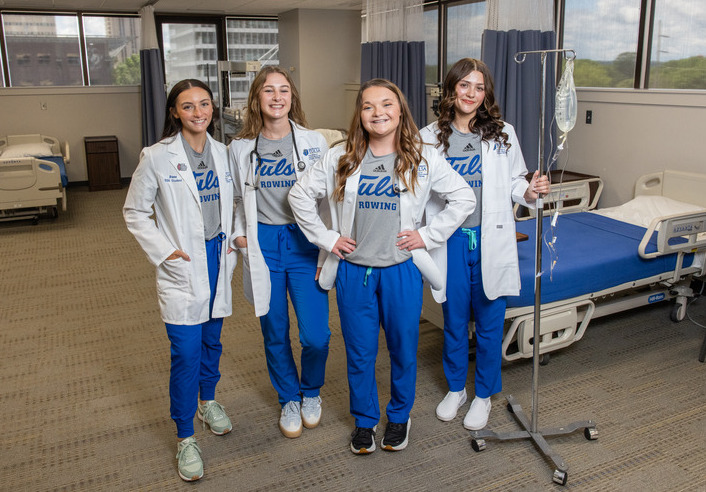
UTulsa’s 2025-26 rowing team includes four nursing students: Cali Campbell, Brianna Gfroerer, Juliana Partida and Sydney Wahle. “We stand apart from many of our peers by deliberately creating a practice schedule that minimizes conflicts between practices and the intense class and clinical demands of the nursing program,” noted Head Rowing Coach Brandon Campbell.
Team members typically train one or two sessions per day, six days a week, in campus gyms as well as at the UTulsa boathouse at Rogers Point Park in Catoosa. Each practice lasts one to two hours, depending on the session’s purpose. “We usually complete our primary practice of the day between 6 and 8 a.m. to ensure we’re done before classes start,” Campbell explained. Team members then fit in their secondary session on their own when they are free.
To accommodate nursing students whose clinical hours might conflict with the team’s practice schedule, UTulsa’s rowing program permits them to make up a session after clinicals or between classes, including some weekends. “It’s certainly challenging for our nursing-student rowers to balance all their responsibilities, but I’ve found they are passionate about both their academic program and their sport. They’re all willing to make sacrifices to excel in both,” Campbell said.
Currently in her senior year, Gfroerer joined the rowing team in January 2024 and serves as its coxswain. “Rowing and nursing speak a similar language,” she said. “Rowing requires hard work and teamwork, which are also essential when caring for patients.”
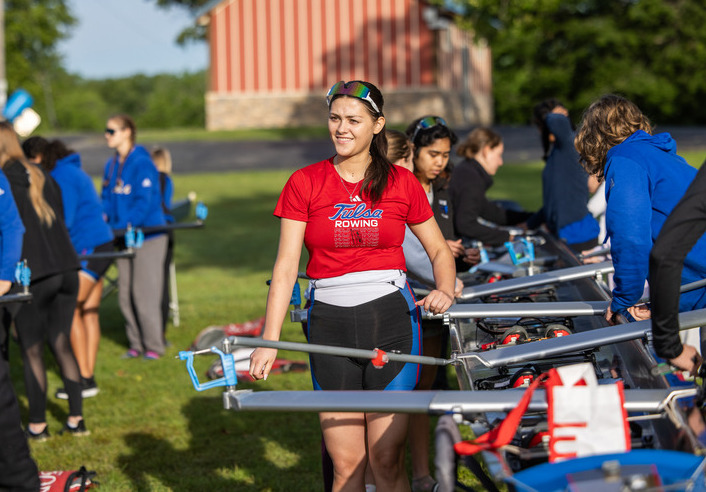
In addition, she emphasized that coxing, in particular, requires communication and leadership: “When we are racing, it’s my job not only to steer, but also to ensure that I know what each of my rowers are doing, how they are working together and what all of the boats around us are doing. Similarly, as a nurse, you need to be able to adapt quickly and communicate when you notice small cues, such as a change in patient condition or response to treatment.”
Rowing on the shell’s starboard side, Partida also sees a deep connection between flourishing on the water and in the classroom: “In rowing, there’s a sharp need for attention to detail to maintain proper technique and speed. I bring that same focus to patient care, scanning everything in the room quickly, thinking critically and being ready to intervene when necessary.”
Waking up at 4 a.m., practicing on the river as the sun rises over Verdigris, and then heading to class ready to engage require discipline. Juggling so many commitments inspires Partida with “a deep sense of accomplishment just knowing I’ve started the day by challenging myself to improve.” She extends this feeling to other parts of her life: “Rowing has given me a sense of steadiness and confidence that helps me take on just about any situation or opportunity that comes my way.”

“Not every nursing student would make a great rower, and not every rower would excel as a nursing student,” Campbell remarked. “But there’s a reason the two are often a match, and it usually comes down to a drive to succeed, a collaborative mindset and exemplary health consciousness – aptitudes Brianna, Juliana, Cali and Sydney share with their teammates.”
That high level of dedication was vividly on display last spring when the UTulsa rowing team took second place at the Big 12 Rowing Championships in Sarasota. “I am so proud of all our rowers,” their coach said. “There are great things in store for them on the water, as they complete their studies and as they embark on impactful careers.”