

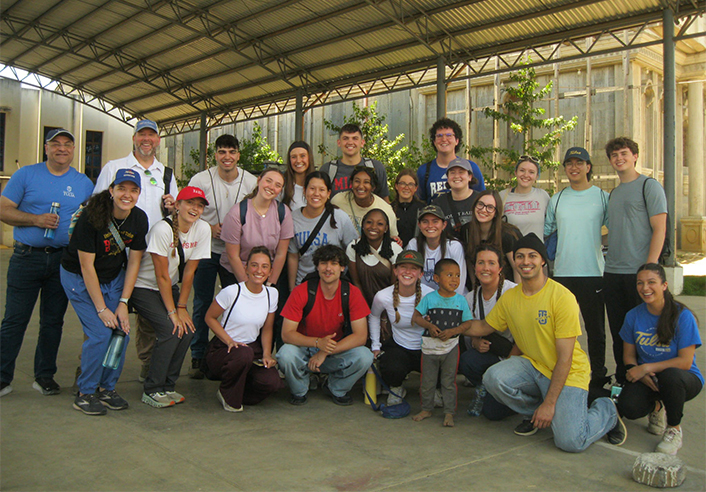
For one unforgettable and impactful week this summer, members of The University of Tulsa’s chapter of Global Medical Brigades spent a week in Guatemala helping people access health care and learning about their culture. The 21 students were joined by their faculty adviser, Clinical Professor of Athletic Training Ron Walker, and Professor of Biological Sciences Mohamed Fakhr.
“I got involved with Global Brigades because I wanted to gain hands-on volunteering experience in clinical settings while also fulfilling my goal of seeing more of the world,” said Brian Yang, a pre-med biochemistry major. “Friends told me great things about last year’s trip to Panama, so I was inspired to give the Guatemala expedition a try.”
After undergoing virtual pre-departure training by Global Medical Brigades and UTulsa’s Center for Global Engagement, participants packed their bags and headed south. During their first afternoon and evening on the ground, the team received hands-on training and orientation at their compound in Chimaltenango. The topics included taking vital signs, clinic logistics and documentation requirements, as well as sorting supplies, medications and eyeglasses.
The rest of the group’s time in Guatemala comprised a field research day, three clinical days and two days exploring some of the country’s scenery and culture. During the research day, students knocked on doors in the community, speaking with locals about their access to health care, living conditions and water quality. “This was a fun and informative way to connect with the community while obtaining important information about their lives,” noted Yang.

Clinics took place in Rincón Grande, a rural village about a 70-minute drive from where the students were housed. On those days, students worked alongside local physicians and Global Brigades staff. Their duties included taking patients’ vitals, shadowing physician consultations, assisting with optometry, pharmacy and dentistry and taking part in a “charla” – a presentation for more than 150 local schoolchildren about tooth brushing and flossing. By the end of the three days, 158 people had undergone medical consultations, 152 had received dental care and 67 were sporting new eyeglasses.
“Global Brigades trips are purely about service, which is different than faculty-led study abroad courses and programs,” Walker commented. “I am so fortunate to have been able to join the students in Panama last year and Guatemala this year to witness them practicing the healing arts through love and compassion.”
As a reward for their hard work, on their cultural exploration days, Global Brigades staff introduced the volunteers to some of the area’s fascinating sights. Attractions included visits to street markets, coffee shops, museums, Lake Atitlan and the Spanish colonial town of Antigua (a UNESCO World Heritage site).
For Yang, one of the highlights was the friendliness of the people the students encountered. “All the individuals and families we worked with were very open and appreciative,” he noted. “They always greeted us with big smiles and were patient with our broken Spanish. The community even gave us fresh strawberries as a gift.” Beyond that valuable feel-good factor, Yang noted, “being able to work firsthand in the medical field reinforced my goals and dreams of becoming a physician.”
Inspired to get involved with UTulsa’s Global Brigades chapter? Reach out to Professor Ron Walker at ron-walker@utulsa.edu.