



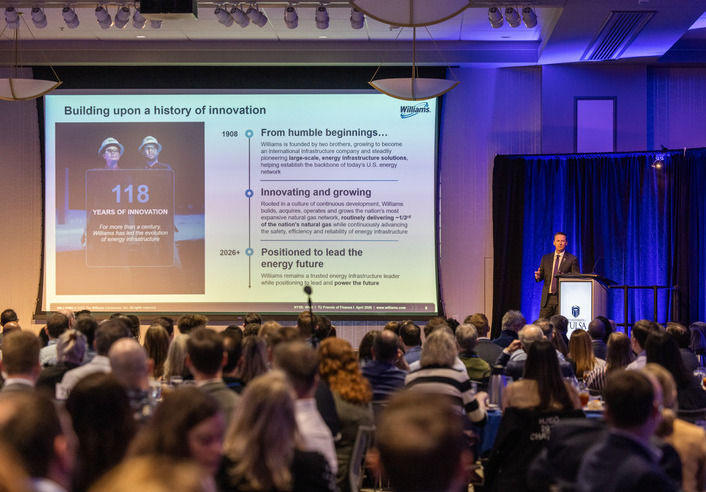
During the sold-out April Friends of Finance Executive Speaker Series luncheon at The University of Tulsa, Chad Zamarin, president and CEO of Williams, said Tulsa must compete harder for companies and talent. The city and state risk losing more employers and workers unless critical investments are made, he said.
Zamarin spoke about the future of energy infrastructure, the growing role of natural gas and the importance of location decisions for major companies. He said Williams expects significant growth in the coming decade and needs a city that can grow with it. “We want to be in a city that is going to do big things and grow over the next 10 years,” Zamarin said.
Founded in 1908, Williams moved to Tulsa in the early 20th century. Today, the company operates one of the nation’s largest energy infrastructure networks, handling roughly one-third of U.S. natural gas through its pipeline, gathering, processing and storage systems.
Much of Wednesday’s presentation focused on increasing demand for natural gas and electricity. Zamarin said the United States has become the world’s leading producer of natural gas and argued that infrastructure expansion will be essential as demand rises from exports, manufacturing and data centers.
He said speed is critical as artificial intelligence drives new power needs. “We are not going to win the race for AI if it takes six to eight years to scale up our AI infrastructure,” Zamarin said.
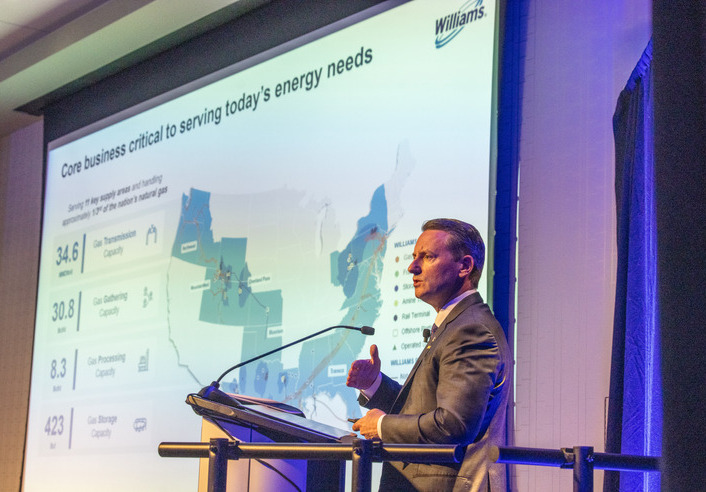
During a question-and-answer session, attendees asked about LNG growth, alternative energy sources and regional development. Zamarin said Williams continues to evaluate energy sources such as solar, hydrogen and nuclear, as well as battery storage technology, while focusing on projects that could be deployed at scale in the near term.
He closed by returning to Tulsa’s future. Zamarin said attracting top employees has become tougher and pointed to a decline in Fortune 1000 companies headquartered in Oklahoma since 2015. Factors such as schools, public safety and infrastructure investment influence where people choose to live and work, he noted.
“The most important thing for us is to be able to attract the very best and brightest to our headquarters city,” he said.
Zamarin said Tulsa has strong potential, but reversing that trend will require action from business and civic leaders: “We better start expecting more and doing more with it, or we’re going to keep losing companies and talent.”
Wednesday’s event was the last of the 2025-26 series. The 2026-27 series will kick off in September with new UTulsa President Stacy Leeds. For more information about Friends of Finance or to become a member, visit utulsa.edu/fof.