


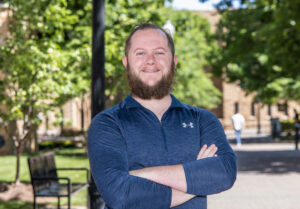

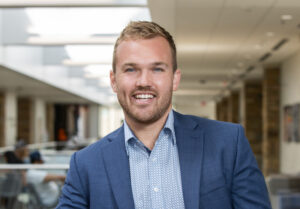
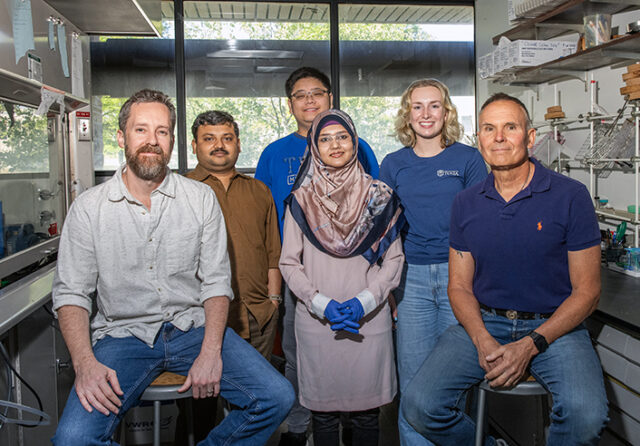
Developing tools that scientists in the pharmaceutical industry can use to make new drugs has long been at the center of research carried out by Angus Lamar, associate professor of chemistry & biochemistry in Oxley College of Health & Natural Sciences. Recently, Lamar and his colleague Gordon Purser, professor of chemistry, were awarded a $500,000 grant to further this work from the National Science Foundation’s Chemical Synthesis program.
The full title of their project, which runs through August 2028, is Intermediary Arene Dearomatization as an Approach for meta-Selective Functionalization of Arenols and Heteroarenols. Its primary goal is to invent new compounds that are valuable in the pharmaceutical industry.
Approximately 75% of all pharmaceuticals contain an aromatic ring – also called an arene – as part of their molecular structure. In the quest to make more effective drugs, considerable effort has been expended to engineer organic reactions capable of predictably modifying aromatic rings.
“Our efforts focus on creating a new, mild organic reaction to modify aromatic rings at locations that, so far, have remained elusive,” explained Lamar, the project’s principal investigator. “Our reaction is unique because we are temporarily converting the aromatic ring into one that isn’t aromatic anymore, thus fundamentally changing its properties and causing it to react in a completely different way. The result of this work will be the ability to produce biologically active compounds that have never been made before to test as drugs.”
A key element of their project is computational chemistry, which entails using math and physics to simulate how atoms and molecules behave. “Think of it this way,” said Purser, “wet lab chemists can carry out a reaction and see the result, but that doesn’t always explain how the starting materials actually turned into the products. Computational chemistry helps fill in that missing story, enabling us to test different possible pathways and rule out those that don’t work while supporting those that do.”
Putting students front and center
Training and mentoring future scientists is a critical part of Lamar and Purser’s project. The NSF grant supports up to two doctoral chemistry students as well as up to 10 undergraduates drawn from an array of majors, including biology, biochemistry, chemistry, chemical engineering and exercise & sports science. Undergraduate researchers typically participate in the Tulsa Undergraduate Research Challenge and many are involved in the 10-week Chemistry Summer Undergraduate Research Program.
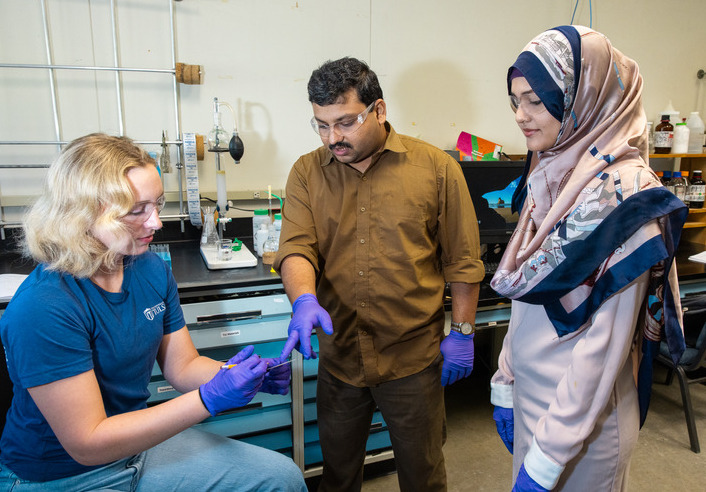
In Lamar’s lab, students apply classical organic chemistry techniques to synthesize, isolate/purify and characterize new compounds. On the computational chemistry side, noted Purser, “our research depends heavily on students’ creativity and problem-solving skills. They help explore different possible reaction pathways, test ideas and interpret results.”
Since joining the team in summer 2025, doctoral student Muhammad Qasid has been involved in optimizing reaction conditions as well as the synthesis, isolation, purification and characterization of purified compounds using spectroscopic techniques. “In addition to helping me sharpen my self-determination and critical thinking skills, participation in this project and the guidance of great mentors have considerably advanced my expertise in synthesis, mechanisms, spectroscopy and laboratory management,” said Qasid.
Part of the undergraduate cadre, Kourtney Koster is a biochemistry senior from Wichita, Kansas. She has been working in Lamar’s lab since her second term at UTulsa, coming on board the aromatic ring project in January. Her main tasks are running new reactions with a variety of starting materials, isolating any potential products via column chromatography, validating that she has successfully synthesized a product using the lab’s NMR (nuclear magnetic resonance) spectroscopy instrument and then characterizing those products.
“Dr. Lamar and the availability of fascinating research opportunities were the main reasons I chose UTulsa,” Koster said. “He has been supportive on every step of my journey, and involvement in his research group has enabled me to learn and practice my laboratory skills as well as how to apply what I’m studying in the classroom to a genuine research setting.”
Koster is also grateful to Purser, whom she credits as teaching her resilience in the face of reactions that do not always unfold as expected. “Dr. Purser has been a terrific mentor, encouraging me to believe in my research and share it with a broad audience,” she said.
And while not yet even a year has passed since work on modifying aromatic rings began, with the aid of their team of engaged and energetic student researchers, Lamar and Purser are already compiling data for the first three publications arising from their investigations. Looking ahead, the duo are now also planning further studies for years two and three that they expect to lead to additional breakthroughs and publications.
Your lab coat awaits
Opportunities to engage in hands-on, meaningful scientific research abound throughout Oxley College of Health & Natural Sciences. If you’re ready to shape the future, we’re eager to help you get started!