




For Sarah Downs (B.S. ’24), an electrical engineering graduate student at UTulsa, the path to advanced robotics research started during her childhood. In middle school, she built robots with Legos, later competing in FIRST Robotics competitions.
Those memories never left her. She found herself wondering if she could translate these experiences into a robotics career. Now, she’s working on projects that could one day support space missions and other electrical engineering avenues, a dream she has nurtured.
A Tulsa native and Jenks High School alumna, Downs started searching for her dream college during her senior year, looking locally, as well as out of state. After touring UTulsa, her dream became a reality with the university’s welcoming atmosphere, state-of-the-art facilities and the opportunity to pursue a minor in Chinese language.
“I fell in love with the architecture and how friendly the professors and staff are,” said Downs. “The equipment was modern, and I thought the smaller class sizes would be more helpful for me.”
In addition to an honors scholarship, Downs received support from her local Girl Scouts chapter, Oklahoma’s Promise and additional federal aid. Choosing a local university has allowed Downs to stay close to family but expand her friend group and explore the growing Tulsa entertainment and food scene.
“Tulsa is just big enough that there’s always something to do. There are events every weekend or a unique restaurant opening,” she said.
Since her undergraduate studies, Downs has joined multiple groups and organizations, including a student fitness and running club. She has also gained leadership experience, serving as a graduate student adviser and peer mentor for the Institute of Electrical and Electronics Engineers, which she credits with helping her to become confident, embracing new challenges and research opportunities.
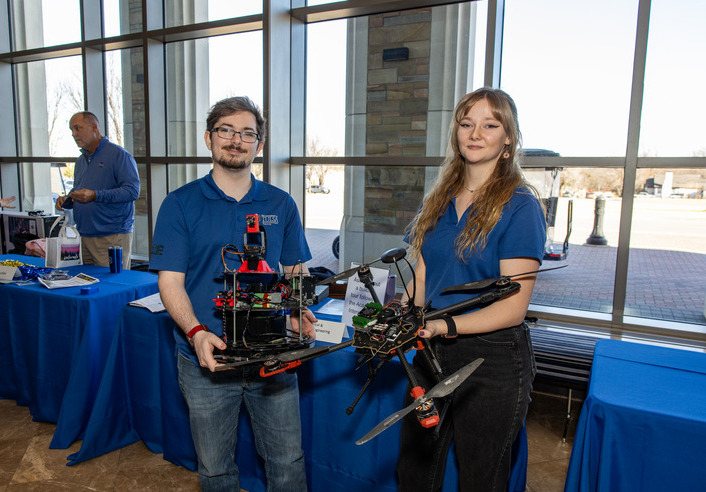
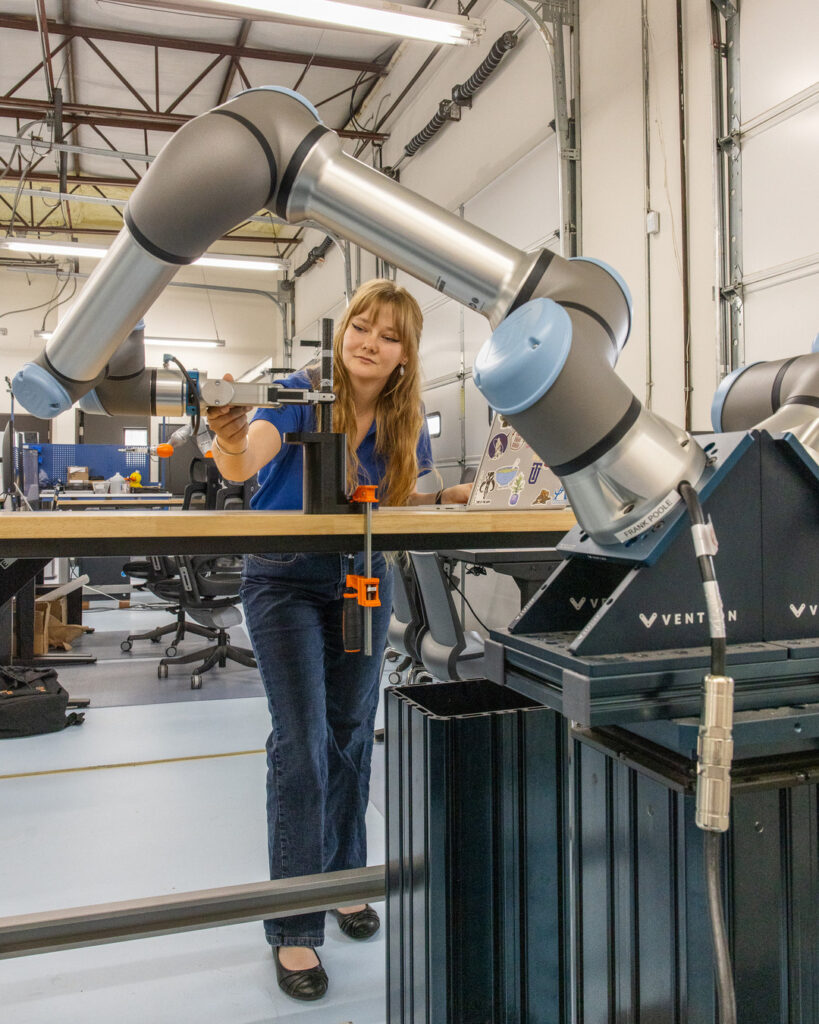
Downs’ research at the university centers on robotics through UTulsa’s Institute for Robotics and Autonomy. She has contributed to a National Institute of Standards and Technology grant, designing an algorithm for robotic assembly insertion using only force and torque sensors, requiring no vision systems. Downs is also part of a contracted project focused on robotic assembly in space, known as the Reversible Thermally Driven Adhesive Project, working with a team of other graduate students. She operates the robotic arm and motion tracking system for testing.
“The institute primarily designs robotic systems and methods to help people age in place,” Downs explained. “That means seniors can stay in their own homes longer and without as much human help. I mainly work on how we assist people with tasks using a robot, like emptying the dishwasher, making the bed or even making a cup of coffee.”
Among the faculty who’ve shaped her experience and later her research interests, Downs credited Douglas Jussaume, applied associate professor, as a key mentor. The encouraging environment and open-door policy Jussaume provided motivated Downs to ask questions and seek advice.
“He’s always supportive of his students. He brings doughnuts for exam days, and his wife bakes pies for our department’s Pi Day,” said Downs. “He taught me how to lead engineers when I took over as president of IEEE and rebuilt it after the pandemic. I was the only woman in my graduating class, and he was an incredible mentor.”
As Downs finishes her master’s program, she emphasized that UTulsa has given her the ability to make her dream a reality: “I’m now technically building robots for NASA. It is a lifelong dream come true.”
Dream careers sometimes require advanced degrees. Explore your options for master’s and doctoral programs at utulsa.edu/grad.