






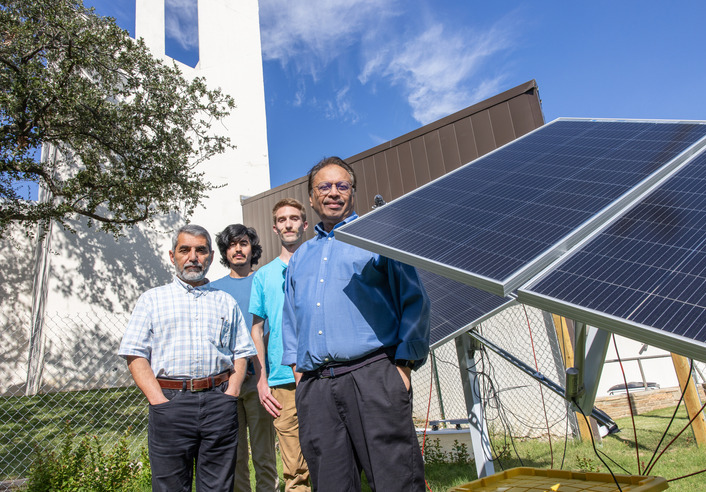
An innovative project is being developed at The University of Tulsa that brings together biology and physics to better understand how solar energy impacts crop growth and water use. The team is led by Parameswar Harikumar, Ph.D., professor of physics & engineering physics, and Akhtar Ali, Ph.D., professor of biological science. The students involved are physics seniors Joseph Blackstad and Daniel Naranjo. From their collaboration, they hope to revolutionize Oklahoma agriculture toward a solar-powered solution.
Previous studies focused on animals grazing under the shade of photovoltaic panels on solar farms. These findings, while specific to geographic locations, missed crucial data on measuring efficiency in plant yields or resource use in shorter crops, such as strawberries or soybeans. To fill these gaps, UTulsa researchers are working to integrate the dual use of a single patch of land, generating electricity and food while making farming more efficient and sustainable.
The Implementation of Agrivoltaics Stations project is designed to collect data on how crops perform under full sunlight, partial shading from solar panels and greenhouse conditions. Harikumar and Ali are leading the team in researching the soil pH, water consumption, humidity, sunlight intensity and plant growth metrics. From the research’s dual interest in solar power, the solar panels’ performance is also tracked under microclimatic conditions.
Construction for the project started in the late summer. Blackstad completed the fence enclosure and installed two solar trackers and their panels with the electrical infrastructure. The plot of land is 20 by 22 feet, providing ample space to monitor plants across varying levels of shade. Naranjo performed the agricultural maintenance and experimentation, making sure the crops received proper care and recording measurements.
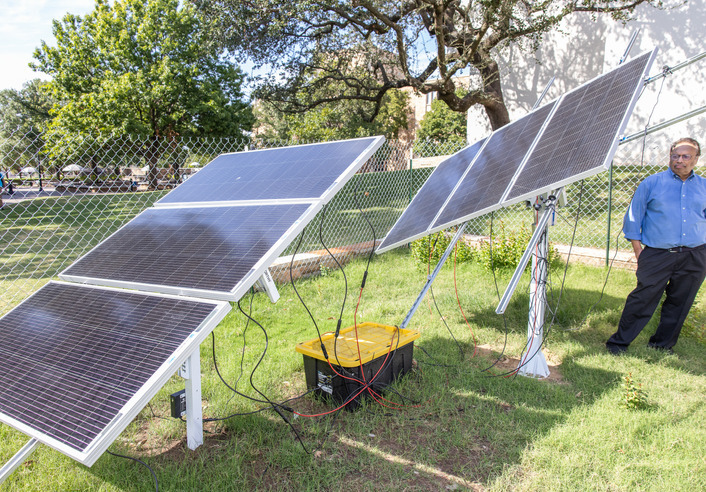
“Agrivoltaics, the practice of combining agriculture with solar energy production, offers numerous benefits, including increased land use efficiency, enhanced crop yields and sustainable energy production,” Ali explained. “This proposal outlines a comprehensive outreach strategy to promote the adoption of agrivoltaics among Oklahoma farmers.”
Findings from this project will answer key questions about crop viability under shade, water conservation and the effect of solar panels on crop growth. On a local scale, the project could aid Oklahoma farmers in drought-prone regions by creating dual-use land that supports both agriculture and renewable energy. In the future, the results of this revolutionary research could reduce water usage during chronic droughts seasons and make agriculture more resilient throughout the United States.
“This project is a great example of what can happen when different disciplines work together,” said Sanwu Wang, Ph.D., the Ruth and William Kistler Jr. Endowed Chair in Physics & Engineering Physics. “Professor Harikumar’s collaboration with Professor Ali and the biology department shows how physics, engineering and life sciences can intersect to tackle real-world challenges like sustainable agriculture. It is exactly the kind of interdisciplinary innovation we strive to support at UTulsa.”