






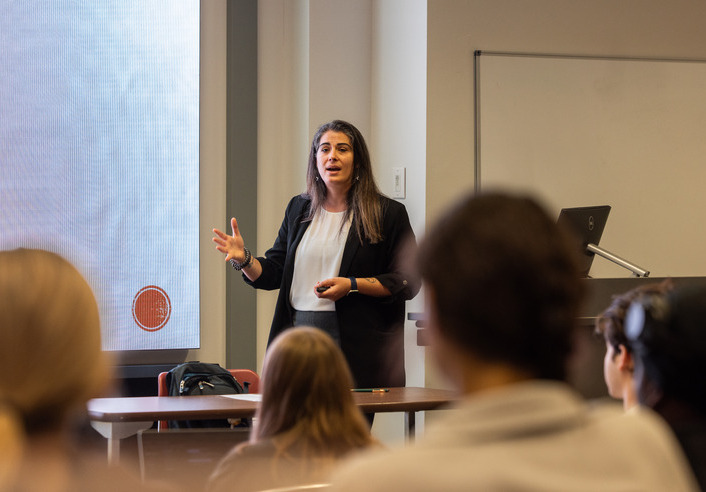
Assistant Professor of Political Science Sahar Abi-Hassan, whose research centers on issues of law, courts and society, joined the faculty in The University of Tulsa’s Kendall College of Arts & Sciences last semester
Abi-Hassan’s research focuses on the Supreme Court, judicial behavior and the role that special interest groups have in shaping case law. “I was drawn to studying the legal system because it brings together so many things I care about: institutions, conflict, power and social change,” she said. “The legal system offers a way not just to study rules and decisions, but it also examines whose voice is heard, whose interests are represented and how institutions shape the lives of real people.”
One of the most overlooked but influential mechanisms for the court is the process of granting cert petitions – the cases the justices are asked to hear. Abi-Hassan’s more recent research takes a look at this process to better understand how the court builds its docket. “One of my most interesting discoveries is how uneven access to the Supreme Court can be,” she said. “The docket does not simply reflect important legal questions the country is facing; it also reflects which parties have the resources, expertise and networks to present the cases the court is likely to hear.”
This discovery has pushed Abi-Hassan to examine representation, agenda-setting and the inequalities of the judicial process more carefully. “It shows how much we can learn by studying not just the cases the court decides but which cases it declines to hear,” she reflected.
Based on her findings, Abi-Hassan plans to expand her research even further, gathering more data on cert petitions, legal advocacy and organized interests. She has a keen interest in how disputes reaching the court shape issues that the justices review. The patterns found through her research ultimately reveal broader, complicated questions about fair access and representation in the American legal system.
For Abi-Hassan, these complex questions aren’t limited to her research; they also inform how she guides her students. She hopes they come away from her classes with an understanding that law is not isolated from politics or society and that analyzing the law through a political science lens helps people understand that the courts aren’t simply legal institutions but are part of a larger system of power, conflict and representation.
She encourages her students to develop habits of asking thoughtful questions and looking at the world around them critically. “The most important thing is to stay curious and ask how rules, institutions and political actors shape societal outcomes,” advised Abi-Hassan. “Don’t be afraid of complexity. Politics and law can feel overwhelming at times, but that’s part of what makes them so important.”
Beyond the classroom, Abi-Hassan has found the curiosity and connection she sees in her students reflected in the larger UTulsa community. “I have really appreciated being part of a campus environment where teaching, mentorship and scholarship are all valued,” she said. “UTulsa offers the kind of setting where meaningful connections with students and colleagues are possible, and that has made a strong impression on me.”