






Researchers at The University of Tulsa are developing a scalable in-space assembly approach that enables complex space systems to be built in orbit. In-space assembly is emerging as a foundational capability for the next generation of satellite and space infrastructure.
As satellites, space stations and exploration systems grow in size and complexity, many components are too large or intricate to be fully deployed from Earth. By enabling systems to be constructed, expanded, repaired and upgraded after launch, in-space assembly removes traditional launch constraints and enables new approaches to space system design. These capabilities reduce mission risk, lower launch costs and support applications ranging from satellite platforms to long-duration human exploration.
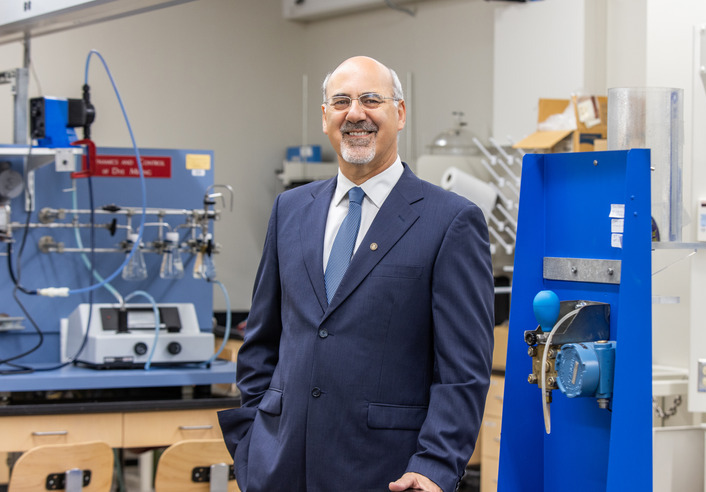
Within this evolving landscape, researchers, working in partnership with ATSP Innovations in Houston, Texas, are advancing a new approach to in-space assembly with direct applications to national defense and future telecommunications. Sponsored by the U.S. Department of Defense, the project is led by Andreas A. Polycarpou, Ph.D., dean of The University of Tulsa’s College of Engineering & Computer Science, whose expertise in design, assembly and thin films anchors the effort. The work reflects a collaborative, systems-level approach that brings together mechanical engineering, electrical and computer engineering, robotics, materials science and industry innovation.
The project team includes Joshua Schultz, Ph.D., associate professor of mechanical engineering, who contributes expertise in robotics, and Peter LoPresti, Ph.D., professor of electrical and computer engineering, who serves as a consultant with a focus on antennas, electromagnetics and orbital communications. Postdoctoral researcher Louis Vaught, Ph.D., leads assembly design and integration, supported by graduate students Sarah Downs and Jack Sorrell.
The enabling adhesive is a patented technology produced by a team of researchers at ATSP Innovations, including Principal Investigator Jacob Meyer, Ph.D., and Neil Rathod, whose materials expertise is central to making the assembly process viable in the vacuum and thermal environment of space.
Titled “Reversible Thermally Driven Adhesive (RTDA) for On-orbit Assembly,” the research centers on the development of an energy-efficient antenna designed for space deployment and intelligence applications.
Current space-based antennas are bulky, expensive and challenging to deploy once in orbit. With these limitations in mind, the team pursued an alternative design that emphasizes modularity and efficiency. Rather than relying on traditional mechanical unrolling methods, the antenna is composed of modular components that snap together like puzzle pieces. The system uses a specialty combination of materials selected to withstand extremely cold temperatures, operate efficiently in orbit and minimize the need for human intervention during installation.
“This project makes things scalable,” Vaught said. “It opens the door to larger, more capable systems without the limitations of traditional designs.”

The antenna is currently being developed for defense applications, with longer-term plans for use in global positioning systems and broader telecommunications. The partnership with UTulsa, the U.S. Department of Defense and ATSP Innovations underscores the role universities play in translating fundamental engineering research into deployable technologies through close collaboration with industry and federal sponsors.
“This project exemplifies the kind of transformative research we garner here at The University of Tulsa,” said Polycarpou. “By developing scalable, energy-efficient solutions, our team is not only advancing national defense capabilities but also laying the groundwork for the future of telecommunications.”
As space missions continue to grow in ambition and complexity, in-space assembly will be essential to enabling systems that can expand beyond the limits of traditional launch-based designs. This work highlights the power of interdisciplinary engineering research to address real-world challenges, while positioning the university as a contributor to the national and global space technology enterprise.
Approved for public release; distribution is unlimited. Public Affairs release approval # AFRL-2026-1456