




It was a record year for University of Tulsa teams who competed in the 2026 i2E Entrepreneur’s Cup presented by Love’s Travel Stops. In total, UTulsa students won over $103,000 in prize money and took first place in both the Undergraduate and Graduate High Growth Divisions.
Six UTulsa teams competed in the annual event in early April, and the results were revealed during an awards ceremony in Oklahoma City on April 23.
“The i2E Entrepreneur’s Cup is one of the most competitive competitions for student founders in the region, and our student entrepreneurs consistently show they can perform at the highest level,” said Chris Wright, director of UTulsa’s Center for Innovation & Entrepreneurship. “What stands out is not just the wins, but the quality of the ventures – teams that are grounded in real customer needs, backed by strong technical and business talent and supported by an engaged network of faculty advisers and mentors. That’s exactly the kind of pipeline we’re building at The University of Tulsa.”
Undergraduate High Growth Division
- GreenSense (Brett Walsh, Hadley Neese, H. Powell Sanders) – First Place ($31,500)
- EcoShield (Selina Jiang, Sievhoung Ly) – Finalist & Black Oak Social Innovation Award ($3,000)
- Glauc (Sarvesh Ramakrishnan, Aaryan Thavaran) – Finalist ($1,500)
Graduate High Growth Division
- Auximotus (Bradford Kerst) – First Place & Black Oak Social Innovation Award ($36,000)
- Verda Robotics (Vusal Karimov, Umnisa Babayeva) – Third Place, Paulsen Scholarship ($16,500)
- AutoScript Robotics (Hagos Shifare, Jacob Hart) – Finalist ($1,500)
GreenSense earns gold
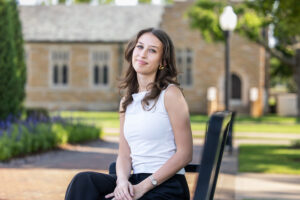
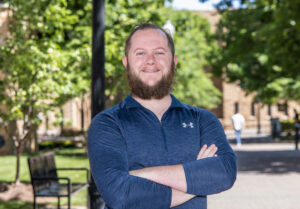
Brett Walsh, a finance junior from Argyle, Texas, is the founder of GreenSense, a golf technology startup focused on improving accessibility in the game. Walsh said he realized that many golfers, especially seniors and adaptive players, struggle to read greens because of declining vision and mobility. This leads to frustration and, in many cases, people stepping away from the game altogether.

“We are developing a real-time haptic feedback sensor that allows golfers to feel the green’s slope, making putting more accessible for those who need it most,” Walsh said.
Knowing thousands of dollars in prize money were on the line, Walsh and his team spent a significant amount of time researching and perfecting their slide deck for the competition. He credits UTulsa faculty and staff members Chris Wright, Nathan Woolard and Taleya Mayberry-Smith for preparing them to present at a high level.
“It was both challenging and rewarding to present alongside so many strong student-led ventures from across the state,” Walsh explained. “For our team, it was a great opportunity to test the sensor in a competitive setting and continue seeking funding for GreenSense. It was very comforting to have my advisers travel with me and sit in the back of the competition room, encouraging me at every step.”
The GreenSense team will soon start building and testing their first working prototypes. They’re applying to national pitch competitions and accelerators in hopes of earning more funding.
“Winning the Entrepreneur’s Cup is nothing short of a blessing,” Walsh said. “It wasn’t just our team who earned this award; it belongs to everyone in our UTulsa community that has poured into our success. I am so grateful to call Tulsa my home. The trophy and check are a huge validation of what we’re solving and the impact GreenSense can have, and this is just the beginning!”

EcoShield earns Social Innovation Award
Selina Jiang, an economics and marketing senior from Skiatook, and her partner, Sievhoung Ly, teamed up to create EcoShield, which is focused on reducing plastic waste in the U.S. healthcare system. Jiang says their goal is to target the significant amount of single-use plastic generated from sterile medical device packaging. Their solution is a biodegradable plastic alternative that can be integrated into existing manufacturing processes, reducing environmental damages, including greenhouse gas emissions, while maintaining safety standards.
The EcoShield team participated in UTulsa’s Hurricane Pitch Competition last fall and then refined their idea to prepare for the i2E Entrepreneur’s Cup. Jiang said she never expected to become an entrepreneur during her college career, but she has enjoyed the competitions and found the process rewarding.
“Looking back, being at UTulsa has really opened a lot of doors for me because of the available resources and hands-on experiences like this. It has been a defining part of my college journey that I will forever treasure after graduation,” she said.

Auximotus tops Grad High Growth Division
Doctoral mechanical engineering student Bradford Kerst (B.S. ’18, M.S. ’20) designed a device to help patients improve head and neck control, a vital need in pediatric and neurological rehabilitation. With guidance from UTulsa Professor of Mechanical Engineering Joshua Schultz, Kerst created the company Auximotus, aiming to give physical and occupational therapists a consistent and safe machine to guide head movements during therapy sessions. The team plans for the technology to assist patients with severely impaired mobility like cerebral palsy, amyotrophic lateral sclerosis and post-stroke neuromotor deficits.
In addition to winning first place in the Graduate Student High Growth Division, Auximotus also earned the Black Oak Social Innovation Award, bringing the team’s total winnings to $36,000. Kerst was also recently selected for the U.S. National Science Foundation I-Corps, an immersive program designed to accelerate lab research headed to market.
Verda Robotics Aims to Help Farmers Using Robotics, AI
The Verda Robotics team earned third in the Graduate High Growth Division, in addition to the Paulsen Scholarship, bringing their winnings to $16,500. Petroleum engineering doctoral student Vusal Karimov and master’s in business analytics student Umnisa Babayeva, both from Azerbaijan, worked with Wright and Kazim Topuz, a UTulsa associate professor of business analytics and operations management.
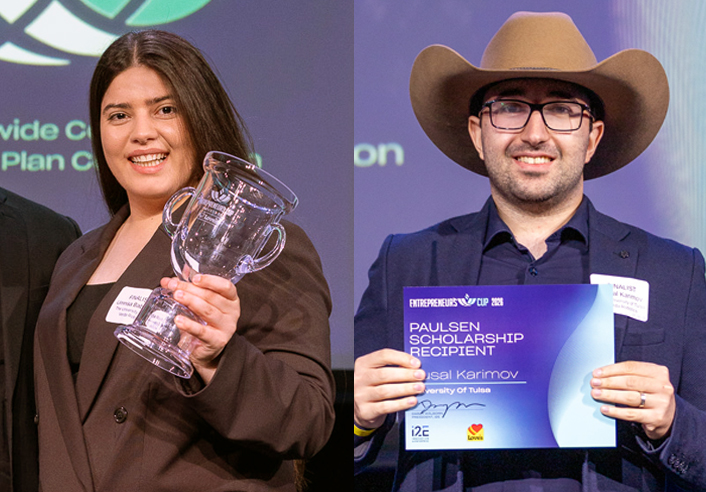
“They encouraged us to think more clearly about our business model and to communicate our ideas in a simple and direct way,” Babayeva said.
The team developed an autonomous ground-level robot that moves through crop rows, capturing detailed plant-level images and data from the field. That data is then processed by artificial intelligence models, which are trained to detect early signs of stress, disease or nutrient issues. The goal is to help farmers catch problems early and respond in a targeted way before issues turn into significant losses.
“Through Verda Robotics, we are addressing critical inefficiencies in global agriculture,” Karimov said. “Specifically, the lack of ground-level data that leads to preventable crop losses and chemical overuse. Our autonomous rovers use computer vision and deep learning to provide real-time, plant-level diagnostics. This helps tech-forward, large-scale commercial farmers improve sustainability while significantly reducing their labor and input costs.”
Innovation to investment to in-production
The University of Tulsa helps students turn their start-up dreams into reality. Learn more about entrepreneurship at UTulsa.