


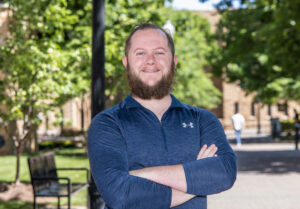




The local chapter of the Albert Schweitzer Fellowship was proud to welcome four University of Tulsa students to its 2025-26 cohort. LaCrisha Crawford, Lauren Prince, Nazila Hamidi and Emmanuel Okeowo are honing leadership skills while undertaking projects aimed at addressing health, legal and education needs in their communities.
“In the first few months of their fellowship year, LaCrisha, Lauren, Emmanuel and Nazila have shown remarkable leadership skills, working with community and academic partners to solve problems, find consensus and embrace creativity,” said Emma Morris, director of the Tulsa Schweitzer Fellowship. “As they transition from planning their projects to implementing them, I’m excited to see their continued curiosity, service and growth.”
Support for justice-involved youth and their families
A student at the UTulsa College of Law, Crawford has partnered with the Family Center for Juvenile Justice and the Tulsa Public Defender’s Office to create Never Alone, a support group for parents and caregivers of justice-involved youth. “I know what it’s like to watch families navigate the juvenile court system in isolation,” she remarked. “My vision for Never Alone is a space where families feel heard, supported and better equipped to face the challenges ahead.” The group also offers a parallel program for the youths themselves, connecting them with mentors, creative outlets and skill-building opportunities.
Never Alone blends Crawford’s passion for advocacy with her goal of becoming a criminal juvenile attorney. “My legal education helps me bridge systems and communities,” she said, “ensuring that families know they are not alone. I firmly believe that when support grows, hope grows, too.”
Accessible mental health care for high school students
Dovetailing with Crawford’s concerns, Prince is partnering with Tulsa’s Phoenix Rising Alternative School, which serves high school students who are involved, or at high risk for involvement, with the juvenile justice system. Her project aims to address barriers to mental health care by implementing a free weekly skills group that teaches Phoenix Rising students coping skills and ways to improve their self-efficacy.
Enrolled in UTulsa’s clinical psychology doctoral program, Prince was motivated to pursue her Schweitzer project because of her passion for justice and a belief that “everybody deserves quality mental health care – regardless of insurance status – at days, times and prices that make it widely accessible.” Beyond meeting the needs of an underserved population, Prince says her project is also “fueling my development as a therapist and teaching me valuable lessons about leadership.”

Combating maternal morbidity and mortality
In addition to completing his final year in the doctor of nursing practice in nurse anesthesia program, Okeowo is using his time as a Schweitzer Fellow to address the rising rates of maternal morbidity and mortality among minority groups in Tulsa. His project arose from a conviction that “all women, regardless of socioeconomic status, racial background or geographic location, should have access to equal and equitable prenatal and postpartum care.”
Partnering with Oklahoma Birth Equity Initiative, Okeowo is developing and implementing a community-based approach to maternal safety bundles and early warning systems. “By the time my project wraps up, I intend to have in place accessible resources on maternal health education, healthy birth spacing and early warning signs,” he explained. “I am also committed to enhancing the existing doula prenatal curriculum so that it reflects current evidence-based practice guidelines.”
Making science accessible for young girls
Currently pursuing a doctorate in chemistry, Hamidi is the first chemistry student to become a Tulsa Schweitzer Fellow. With the input of local STEM organizations, mentors and community organizations, she has spent the last few months designing a weekly after-school science club for girls in grades three through five at Sequoyah Elementary School in Tulsa.
A desire to form this club arose from the role models who, when she was young, showed Hamidi she could excel in science. “That’s a gift I want to pass on through my Schweitzer project,” she commented.
Hamidi explained that the main goal of the club, which launched in September, is “to spark curiosity, build confidence, and show these girls they belong in science” through hands-on experiments, visits from female STEM role models and field trips to science centers. “Beyond empowering young girls to see themselves in science,” she added, “I hope this club helps to close the gender gap in STEM.”
Tulsa’s Schweitzer Fellowship program launched in 2016. It is housed at UTulsa’s Oxley College of Health & Natural Sciences and is one of 10 Schweitzer Fellowship sites across the United States. To date, 111 Tulsa Schweitzer Fellows have contributed more than 23,000 hours to improve the lives of over 8,000 under-resourced Tulsans in partnership with over 70 Tulsa and Eastern Oklahoma nonprofits, schools and clinics.